
The Point of Points
Hidden Psychology of Loyalty (Part 1) — Building a Better Mousetrap Part 2 — Points of Points | Why Easy Rewards Backfire — Part 3
Mark Sage - 10 min read - 2/09/2025
Asda’s first foray* into loyalty looked, at least in the beginning, like a runaway success. Launched in 2022 under the strapline “Pounds not Points”, ASDA Rewards was a loyalty programme that felt different.
It wasn’t just another points scheme, it was cash in your pocket. Within a year it had more than six million active users and won glowing press coverage for breaking the mould. For a business that had always resisted loyalty, it was a breakthrough moment.
The positioning was clear — Asda would do loyalty, but do it their way.
By April 2024, Marketing Week was celebrating the model with the headline: “Asda hails price focus and loyalty scheme for delivering value” — and reporting how loyalty had contributed to their strong sales growth of 5.4%. The message was simple — price first, loyalty as a value-delivery mechanism, and a clear line to the customer — Pounds, not Points.
And then, it all went a bit Pete Tong.
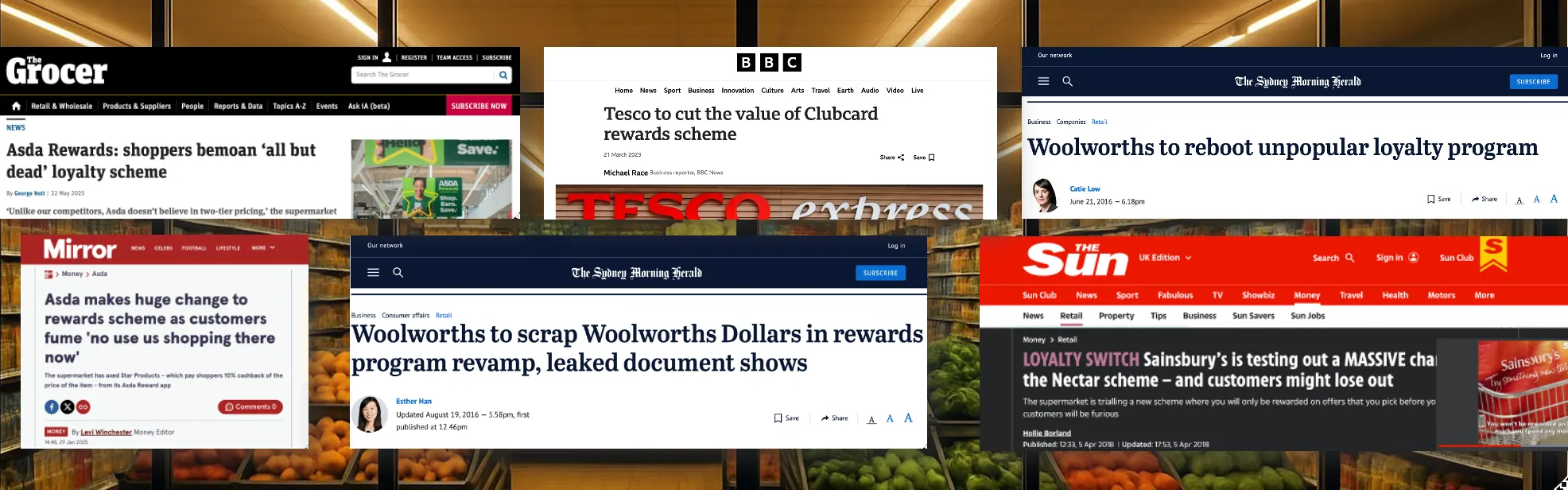
By 2025, the shine had worn off. Former CEO Allan Leighton returned as Executive Chairman and reset the company’s stance, arguing the scheme needed to be “democratised” — and that “whoever you are, if you shop at Asda, you should get the same price”. Within months, the mood music changed. Customers began to vent online, and by May, The Grocer was reporting that shoppers were bemoaning an “all but dead” loyalty scheme.
Leighton has since doubled down on his stance — “Asda doesn’t believe in two-tier pricing” — and by extension, you could argue it doesn’t really believe in loyalty marketing at all. For Asda, price remains the single reason to shop, and in their eyes, it takes a 10–15% price gap to win.
The rise and fall of Asda Rewards reveals something deeper than corporate philosophy. It shows that customers want more than just headline discounts or promotional gimmicks. They want base value.
They want to know that every shop counts, that the programme is always there for them, not just when the stars align. Strip that away, and even six million customers and all the PR in the world can’t save you.
Tesco took a very different approach when faced with competitive pressures. They trimmed back some of the old value leakage from loyalty — reducing Clubcard Deals from four times to two times — but crucially, they leaned harder into the programme itself.
Clubcard penetration was driven up, with member pricing locked in across thousands of SKUs, and loyalty became the gateway to value. Rather than chasing the discounters like Aldi to the bottom, Tesco used loyalty to hold the line — and in 2025 they increased their market share to 28.5%, its highest level since 2016.
The lesson is hard to miss — loyalty can be as much a defensive weapon as an offensive one. One retailer chose to strip loyalty away, the other chose to weaponise it.
Moving aside Asda’s ideological position, it could be argued that had they leaned into their programme, rather than sidelining it after a few short years, they may have been able to both own “low prices” and customer loyalty.
I’m highlighting these stories though to show the quandary that faces all retailers when considering loyalty — how to manage that customer value exchange.
Get it right, and you make customers happy; get it wrong and you make the headlines.
The base cost of loyalty — whether funding 10% off Star Products for Asda, or 1% base points earn for Tesco — is significant, so you want to be sure you’re maximising the benefit.
When we were designing yuu Rewards, it was clear that we’d have a base points currency. That doesn’t automatically mean it was an easy sell, I simply mean that to have a coalition loyalty programme, you really need to have a base points currency.
The base points do two things.
Firstly, they ensure consistency of the earn message across all partners, products and categories. The principle of “1 point per $1 HKD” makes for a straightforward marketing message, which is then easy to communicate and easy to remember.
Secondly, they ensure a fungibility in purchase recognition. It doesn’t matter what you buy, or how you spend, it all breaks down to 1 point per $1.
This levelling of choices enables you to stitch together different categories and partners — from home insurance to homewares, F&B to pharmacy, travel to trainers. That simple base points proposition connects them all.
It also gives an easy way to communicate extra value — Double Up, 3x Points, 500 Bonus Points. The base currency just keeps giving.
And in doing this — simplifying the marketing messages and simplifying partner purchases — it reduces the cognitive load of participation. For the customer, you don’t need to worry about what products or what offers. There’s nothing to remember, no complex caps, no thresholds to meet, no immediate change of behaviour — no choices to be made.
Every basket and every visit counts.
This matters because if customers have to chase recognition and value — through challenges, coupons or selective bonus points — they are effectively wading through choices. More choices mean more thinking, and more thinking leads to lower participation.
Behavioural research consistently shows that too much choice reduces engagement. In the famous jam study, shoppers presented with 24 jams were one-tenth as likely to buy as those offered just six.
More recent eCommerce studies echo the same. In a research study looking at Alibaba eCommerce across 1.6m consumers, they found that the number of recommendation choices or decisions a customer has to make has a direct impact on the likelihood of them following through — in this case to make a purchase. Just moving from two to three choices significantly reduced purchase likelihood
With choice, simplicity drives participation; complexity drives drop-out.
The digital platform we were building for yuu Rewards had strong parallels to eCommerce — serving up recommendations for members to encourage purchase behaviour. It’s logical to assume we could expect a similar ‘choice overload’ effect if members had to chase down every offer simply to unlock value in the programme.
This meant that the base currency in yuu Rewards wasn’t simply a decision to enable wider coalition partnerships, it was also a strategic decision to ensure we maximised our reach and engagement.
We still brought “choice” into the programme design — but as an additional layer, through offers and challenges, that could enable the member to unlock further value.
These choices though had to work harder.
In-app offers showed a more than 3x drop-off in engagement beyond the first couple displayed. Challenges were largely ignored at first, and only over a period of months, with progressive waves of challenges, did members start to acknowledge and participate in them.
This isn’t a problem when these mechanics are value add. But if they are the only way to earn value, then members are far more likely to give up before giving in.
The lesson here is that to maximise participation, you need to minimise cognitive load for the basics of the programme.
When overlaying additional choices like targeted offers or challenges, recognise it will take time for members to see them, and prioritise relevance and simplicity over choice.
Of course, there are different ways of structuring points — with some retailers targeting specific categories or products, or targeting specific behaviours like basket size. Less base points earn and more bonus.
Woolworths in Australia famously overhauled its loyalty programme back in 2015 with a scheme that saw customers earning Woolworths Dollars — but only for products displaying an orange ticket. In principle this sounds great — members earn more on selected products, and Woolworths can direct spend, with most of it funded by suppliers. A win-win.
Except it wasn’t.
The Sydney Morning Herald reported “thousands of customers hitting the phones to complain it was too hard to earn Woolworths dollars”. Suppliers refused to participate, arguing the economics didn’t stack up compared to regular promotions. Customers couldn’t find deals, and the scheme collapsed after just 10 months. Woolworths quickly reinstated a base points mechanic, giving 1 point for every A$1 spent. It was an expensive experiment.
There are however examples of ‘bonus points’ led schemes that do appear to work, and Carrefour is the poster child.
Within their Le Club programme, 14m members earn cashback (cagnotte) alongside wider member benefits like a Friday fuel discount. Carrefour Spain’s El Club similarly offers 1% cashback to its 10m members. On the surface this feels different to points, but in reality it isn’t. Loyalty currencies can be called anything — points, miles, stars, cash — but the mechanics are the same — expiry dates, redemption limitations, single-use vouchers, or variable partner values.
What’s smart about Carrefour’s scheme is its ability to unlock CPG funding. Whereas Woolworths failed to get suppliers onboard, Carrefour makes it work.
The Euro-denominated cashback pot feels like “money back,” which makes it easier to secure manufacturer participation. In practice it’s no different to points, but perception matters — and the perception of cash works well with both consumers and suppliers.
There is though no base earn. Instead, they leverage a 10% bonus earn model, with customers rewarded for buying certain own brand products and categories. These own brand categories are basically core fresh / ingredient categories, so Carrefour is clearly targeting high frequency, large spending family baskets — those cooking at home. Additional value can then be unlocked through participating supplier products, their co-brand credit card, and even partners like Uber Eats.
Whilst this means not every purchase counts, the penetration of their own brand — reportedly 36% of sales in 2024 — helps to ensure that for most customers, most baskets will be earning value.
On paper, Le Club is a successful programme — 14m shoppers engaged, strong CPG participation, and reinforcement of own-brand and fresh categories.
However, if you run the numbers, Carrefour’s loyalty penetration in France is broadly proportional to its market share. Fourteen million members in a country of 67m gives it coverage of around 21% of the population, against a grocery market share of roughly 20%. The ratio is essentially one-to-one — loyalty covers Carrefour’s natural footprint, no more, no less.
Tesco, by contrast, tells a different story. With 23m Clubcard households in a UK population of similar size, penetration rises to 34% against a 28.5% share. That’s a 20% over-index. This means that Clubcard extends into lighter buyers and occasional missions, pulling in households that don’t give Tesco the majority of their spend.
Sainsburys Nectar, as a coalition, goes further still. With 18m members in the UK, it penetrates 27% of the population against Sainsbury’s 15–16% market share — a 70–80% over-index, thanks to its coalition design.
This is pseudo-science, of course, but the contrast is telling.
Carrefour’s cashback mirrors its share, Tesco’s base-points model stretches beyond it, and Nectar’s coalition structure reaches furthest of all. If growth follows penetration, then clearly more penetration means more room to grow.
The point isn’t that coalition always “wins” — Tesco still commands the stronger share — but when it comes to marketing reach, the numbers speak for themselves. Base points deliver broader coverage than bonus-only models; coalition expands reach further still.
Back to Asda and their “Pounds not Points” programme. In many ways, this was similar to Carrefour’s Le Club — but without the same base value. Whereas Carrefour makes most baskets feel worthwhile through own-brand and fresh penetration, Asda’s narrower offers and higher cognitive load likely dampened participation.
With a UK grocery share of 14.1% in 2022, Asda’s six million members translated to just 9% of the population — under-indexing by 36%. That’s a gap of almost 3.5m customers potentially missing from its programme.
With yuu Rewards launching as a coalition, linking together not only Dairy Farm brands, but wider brands and services within Hong Kong, a base points currency was a natural fit.
It would help us build participation, maximise reach, and stitch together partnerships across categories. We knew that it would ultimately allow us to punch above our weight, and capture a larger share of shopping missions and lighter buyers — just as Nectar had demonstrated in the UK.
However, bonus-point and supplier-funded models will always be tempting. On the surface, they create the illusion of loyalty at a cost that feels board-friendly, with much of the spend carried by suppliers rather than the retailer. But the trade-off is stark. You risk limiting customer reach and long-term value, and when the offers thin out or feel arbitrary you risk enraging customers rather than engaging them.
What looks efficient in a spreadsheet can quickly unravel in the store.
That said, base points are not a panacea. In my opinion, they’re the foundation for a strong programme, but on their own they can’t unlock all the value. If you rely on them too much, collecting becomes passive. Simplicity may reduce cognitive load, but it also risks reducing engagement. In the UK, Nectar suffered from this passivity for many years, while Tesco found ways to keep engagement active with mechanics like Clubcard Deals and differentiated pricing.
At yuu Rewards, we learnt the lessons from both and this fed into our design philosophy.
Base points formed the game loop — reducing cognitive load and making every basket count — but they were layered with partner offers, challenges, and missions to unlock more. The foundation was simple; the engagement came from variety.
The choices we made back then helped to propel yuu Rewards forwards, and the results are striking.
With over 5 million members in a city of 7.5 million, the programme now reaches around 67% of the population. Set against Wellcome’s grocery share of roughly 31%, that means its over indexing by an extraordinary 110% — capturing more light buyers, more non-grocery missions, and more lifestyle spenders. This not only re-affirms the power of coalition loyalty to broaden reach, but also the quiet strength of base points to connects it all together.
But points aren’t the point — participation is. Loyalty that stops at points risks fading into the background; loyalty that’s designed for participation creates habit. That’s the distinction we built into yuu Rewards — base value as the entry ticket, reinforcement as the engine.
In the next article, I’ll explore the psychology that makes programmes habit-forming — and how those mechanics became the backbone of our design.
[*] Technically, I’d argue this wasn’t the first loyalty programme from Asda. For those interested in a little background, feel free to read my article from 2011 discussing their first attempt at loyalty.