
Why Big Goals Fail
And How Leaders Kill Momentum Without Realising It
Mark Sage - 11 min read - 26/11/2025
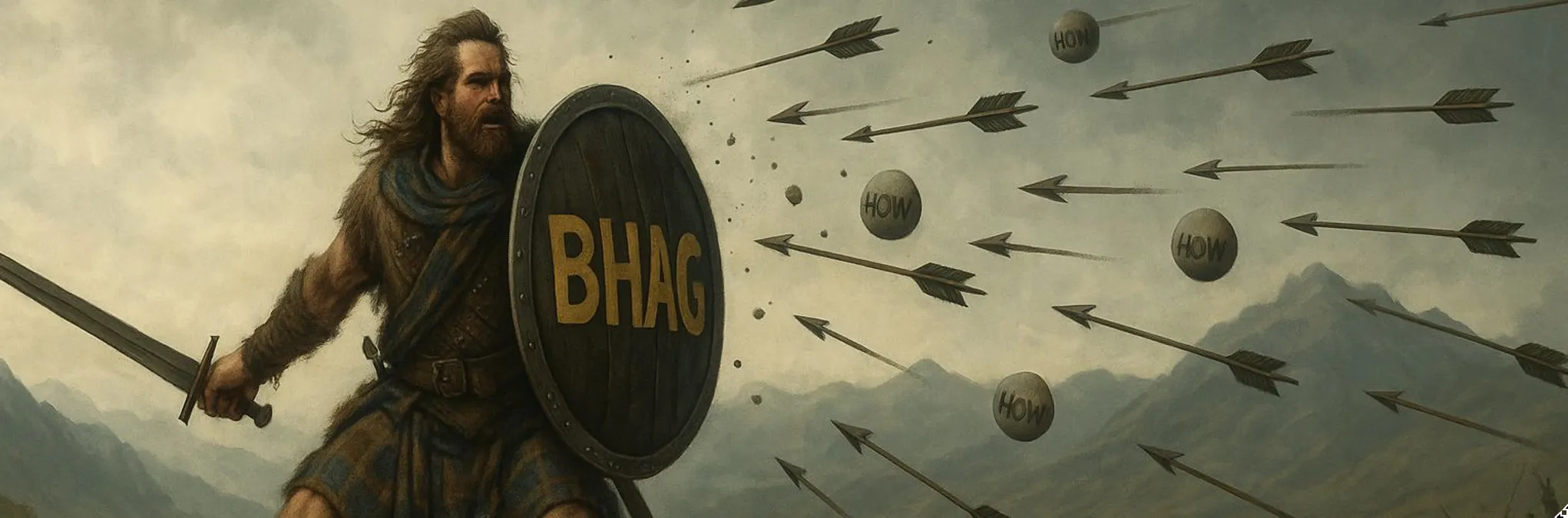
Most great ideas die early — not because they’re bad, but because someone asked ‘how?’ too soon.
This concept really came to life for me when I was listening to an interviewwith Tony Robbins — the author, coach and philanthropist — as he discussed the topic of goal setting.
He said one of the challenges many people have when setting a goal — a really big goal — is that they get into the ‘how’ too quickly, and that this essentially kills off the dream and the goal.
The focus he said should be on the ‘what’ and the ‘why — to really build these out so that you can almost touch them.
Know what you’re trying to do and why that’s important — get strong on these and get reasons to be excited for the target. If you start thinking about howyou’ll do it at this point, it will breed uncertainty. Uncertainty leads to fear, and fear is the enemy of achieving that goal.
This is the tyranny of ‘how’ — trying to overthink how you’ll achieve the goal before you’re set on why it needs to be achieved. Doing this will essentially water it down or could even kill it off completely.
Instead, set the goal, make it big and get excited about it. The ‘how’ will come later and will typically be revealed in steps.
In my time at yuu Rewards, we experienced both the benefits of not worrying about the ‘how’, as well as the challenges of focusing too much on it.
If the tyranny of how can kill momentum before it starts, then the antidote lies in the BHAG — the big, unmissable what that unites a team
Big Hairy Audacious Goals (BHAGs)
In the book Built to Last by Jim Collins, he describes the concept of a ‘Big Hairy Audacious Goal’ as being something that is “clear and compelling and serves as a unifying focal point of effort — often creating immense team spirit”.
This ties back into the ‘what’ and the ‘why’ that Tony Robbins said was needed for any big goal — people need to understand exactly what the ask is and why that is important.
Another aspect of this though is that it needs to be ‘big and hairy’. The goal should feel challenging and almost impossible to reach. It should be stretching the team and making them feel uncomfortable and excited in equal measures. Ultimately it should be something you’d ‘clear the decks’ for.
In contrast, if the goal is too small or there are too many of them, then that focal point won’t manifest, and there will be no consensus around the approach or the priority. If people don’t feel compelled to stop what they’re doing to achieve this goal, then the goal isn’t ambitious enough.
In loyalty, we often think about incremental gains — 1% shifts in penetration, a few more app opens. But loyalty success, especially at launch, often comes from BHAGs — goals that feel too big, too fast, but that unify effort.
This concept was really brought to life for me when I was at leadership talk given by Josh Morris. That name may not mean much to you, but I’m sure you’ll remember the event he was linked to.
Back in July 2018, the world watched as 12 boys and their football coach, who had been trapped underground in a Thai cave for 18 days, were rescued — and Josh was one of the key people involved in that rescue operation.
The overall operation involved 10,000 people including 100 divers and 2,000 soldiers. Over that period, there were many different plans to try and rescue the boys such as finding alternative entrances, pumping out the water or drilling a new access point. Josh described how during this period, there was almost a feeling of competition between different teams and different agencies as people tried to be the one to get the result. Communication didn’t flow and resources weren’t focused.
In the end though, with time running out as water levels continued to rise, the only plan that could now feasibly work was to underwater dive the boys for long distances through the cave network.
When Josh described this operation, he talked about how once that approach had been agreed and the team had a ‘unanimous goal’, all the egos across the teams dropped away. Whether local or foreign soldiers, volunteers, rescue experts or government officials, the emergence of a single, focused and massive goal meant that the whole team rallied around the cause.
The visit from the Thai Prime Minister to the rescue operations also gave the team the mandate and support they needed. It freed people up from worrying about whether decisions had been ‘approved’ and instead they could really focus on the execution — on getting it done.
Ultimately, despite the massive risks and remote location, all the trapped boys and their coach were rescued.
This is an extreme example, but it shows the power of a ‘Big Hairy Audacious Goal’ to unite people and to really bring them together to deliver truly amazing results.
Looking at parallels to this within a business context, it was clear to me that within yuu Rewards we’d had a number of BHAGs which I believe were instrumental in driving our early success.
In pretty much all cases, these BHAGS were driven by the then Dairy Farm CEO, and they were generally quite specific, focused and timely.
When the CEO wanted something done, he was clear on the ask but also clear on his expectations in terms of timing. Both of these things are important and are ultimately I think, what helped to ensure we delivered.
For me, that was the mark of a great leader — someone who converts their strategy into actionable goals with clear timelines. It empowers the team (especially when leader driven) and removes ambiguity, infighting and politics. As Josh noted, the ego’s just dropped away, and for us, these BHAGs really did “serve as a unifying focal point of effort [..] creating immense team spirit”.
The first BHAG that had been set by the CEO was for the launch of the yuu Rewards programme itself with a digital focus and tight timelines.
The creation of a cross-banner coalition scheme that needed to incorporate not only the internal banners of Dairy Farm but also partners across key consumer categories. This required a single-minded focus to push through the vested interests such as existing programmes the banners may have been running, or the desire for a brand to stay separate. Ultimately, everyone fell into line behind the goal.
But it wasn’t just falling into line, either. BHAGs seem to generate their own gravity — a pull that draws in people from different teams, departments, and even outside organisations who want to be part of it. There’s something deeply human about contributing to something bigger than yourself. A strong, audacious goal becomes a kind of centre of mass — people gather around it, lean into it, and bring energy you could never mandate. With yuu Rewards, this created real momentum, but not through instruction, through attraction.
That momentum carried us straight into the second BHAG — the launch of eStamps.
These allowed members to collect not just points, but also to collect stamps for specific behaviours. The idea emerged around October 2020, barely three months after launch, but it was needed by January to support a major 7-Eleven business plan.
As a team, we had only just come out of hyper-care, and suddenly we had an entire loyalty sub-programme to design and implement in just 2–3 months. It was challenging, audacious, and required us to bend the technology in ways it wasn’t built for — but we delivered.
We were on a roll! I’ve never experienced a team that well oiled. As psychologist Bruce Tuckman might say, we were truly ‘Performing’
It was just as well, because the third BHAG was probably the most audacious of all.
The yuu Rewards launch had surpassed expectations and there was a real desire to build on this — and build fast. Just seven months after launch, we pivoted to introduce digital services into the loyalty app and to create a yuu SuperApp.
It was audacious not simply because of the pivot in terms of customer experience, but also because of the breadth of the ask. Quick commerce (30 min delivery), Scheduled groceries (same/next day), eCommerce (IKEA), hot food (Pizza Hut & KFC), as well as further offerings from Maxims such as cake delivery. As if that wasn’t enough, we also integrated 3 different insurance partners into the platform to provide various insurance products across travel, life, car and home.
That’s a lot of different eCommerce capabilities to bring into the app, especially with a timeline of just 5 months. There was also a lot of business impact — consolidating existing banner eCommerce, setting up new operations and fulfilment processes, and implementing last mile solutions.
Each of these BHAGs initially felt like an insurmountable obstacle — stretching us beyond what seemed feasible. Yet each one clarified our purpose, and each one was delivered on time, on budget, and seamlessly from a customer experience perspective.
Freedom to succeed
Ina sense we had an advantage with these goals in that the CEO really didn’t care so much about the ‘how’. He was super focused on the ‘what’ and the ‘why’ and left it up to us to sort out how we’d be able to achieve it.
In this way, we didn’t have a chance to lose focus or momentum with the ‘tyranny of how’, and it showed the real value of the Big Audacious Hairy Goal to align the team, focus on delivery and remove the egos.
Looking back, it reminded me of a line attributed to advertising great, David Ogilvy when he said, “Give me the freedom of a tight brief”.
He was obviously talking about a brief in a marketing sense, but I think it applies equally to any brief — any request — and he packs so much into that short sentence.
There is a real tension between the idea of ‘freedom’ being balanced with the requirement of a ‘tight brief’. The assumption is that a tight brief is like a set of instructions, but clearly it isn’t, otherwise how could there be freedom. Instead, this tight brief would need to be outcome driven — tell me what you want to achieve. What good looks like. It’s this that needs to be tight, which means you need to be clear on what you want.
But then there is the freedom.
For me, this means that the brief is heavy on the outcome, but light on the solution. Don’t tell us how you want it done. Don’t give unnecessary constraints. Don’t give your ‘ideas’ of how it could be done, which act as walls around any potential solution to box it in.
Instead, give us the freedom to decide how we get there.
Let the team dream and bring our best to the table — to problem solve and ideate. Let us have ideas that fall flat so we can uncover the ideas that fly high.
I hadn’t realised it before, but I’ve always thrived when there is a tight brief because it gave me the freedom to create — and on yuu Rewards, for launch, we had just that.
However, it doesn’t always work like that — and things were a little different from late 2021.
With the success of yuu, there was a desire to capitalise on the platform we’d created and centre all digital activity within one organisation. A new Digital CEO was appointed who looked to bring together not only the loyalty and superapp areas of the business, but also the wider eCommerce and fulfilment aspects — something that had been run commercially as a separate business up to this point.
This new combined business was seeking to build on the great foundation of yuu to enable a new level of depth and breadth within our digital services and offerings.
Whilst the desire to centre all digital services was likely the right approach, as it would allow for greater synergies and focus, it also ushered in a new era around strategic goal setting and management.
Rather than a handful of BHAGs, with a clear focus on the ‘what’ and ‘why’, we had a larger number of activities which were reviewed, reworked and replanned at a very senior level. A number of previous BHAGs were suspended or terminated, only to be restarted months later. New ones were introduced, only to stall again later.
Every goal, whether large or small was looked at in detail as to ‘how’ it would be done, and every step of progress had the same level of scrutiny.
As part of my role as COO for yuu, I had been managing product across loyalty, SuperApp and eCommerce, and was now asked to bring in every screen, for every change, for review.
I paused.
Then said ‘I don’t see every screen for every change — that’s what my team manages. Are you sure you want to see that level of detail?’
The answer was an emphatic yes. There was a real desire to understand howwe were designing, how we were prioritising and how we were implementing things.
And therein lay the problem — we started to get lost in the tyranny of ‘how’.
Rather than having a small number of clear and compelling goals which created fear and excitement in equal measure, we had a large number of smaller goals which had been dissected between teams, and which came on and off the boil in terms of priority.
From my perspective, the result was simply one of treading water. We had the illusion of progress and of a team engaged and busy, but in reality, we had delivered nothing of significance since the SuperApp in the fall of 2021; almost 12 months prior.
It wasn’t that we lost talent or ambition — we simply let the tyranny of how take hold.
The challenge for any leader then, is to set the vision for the team — helping them to visualise the destination and the benefits it will bring… and then getting out of their way to deliver it.
This is the most important point of the whole chapter, so I’ll say it again — leaders need to set the vision, help the team visualise the destination, and then get out of their way.
Give the team that tight brief, then give them the freedom to deliver it.
Sure, the team needs to be held to account for delivery, will need advice on direction, and will need the leader to have their back when challenges arise. But ultimately, the leader needs to know what they want to see and trust in their team to bring that vision to life.
If the leader starts to get bogged down, not only in the what and the why, but also in the how then it starts to breed uncertainty. That uncertainty leads to fear.
Fear if this is the right decision.
Fear as to whether this will now move the needle.
Fear as to whether this will ever happen.
When you have fear and uncertainty creeping in, then delays quickly follow.
At best, people don’t commit, and so whilst they appear to be on-board, they’re not doing anything to progress it. At worst, it creates an opportunity for other agendas, for the idea to be questioned, queried and ultimately quashed.
Focusing on the ‘how’ is really a focus on the ‘now’, but leaders don’t need to know every step — they need to know which summit, and why it matters.
If you set the destination, the how will find its way.
It always does.