
Proving the value of loyalty
Mark Sage - 6 min read - 20/08/2025
Marketers are familiar with the phrase: “Half the money I spend on advertising is wasted — the trouble is, I don’t know which half” — a quote often attributed to industrialist John Wanamaker.
Loyalty marketers, however, might look on enviously at the idea that only half the spend might be wasted. For many, the real question is can you prove any of the spend isn’t wasted?
It’s widely accepted that, when implemented well, a loyalty programme should drive an increase in sales. But proving that impact is a different matter. Most programmes are rolled out across the entire customer base, with no meaningful control group. That makes it hard — if not impossible — to isolate what behaviour would have looked like without loyalty in place.
We faced exactly this challenge at yuu Rewards.
We made the decision to keep the programme completely under wraps prior to launch. It wasn’t just a PR play, it was a strategic move. We wanted to maximise surprise, limit competitive response, and protect our first-mover advantage.
No one expected Dairy Farm to launch a digital-first, app-led, mass coalition loyalty programme — so keeping it secret was key, and that meant keeping it secret internally as well as externally.
Grocery retailing is a small world, and most suppliers are shared across competitors. We couldn’t take the chance that the programme was discussed inadvertently with suppliers or anyone else and so the project was kept well hidden. We ran it from a near-empty floor, set up a separate legal entity with a non-descript name, all to avoid drawing attention. Even the domain name was registered alongside a handful of decoy sites to further disguise our tracks.
All this secrecy though meant that we had no opportunity for in-market testing. We couldn’t pilot. We couldn’t compare. We had to rely on our previous experience to be confident that launching a well-designed loyalty programme would deliver a positive sales lift.
But someone else’s results, in someone else’s market, rarely satisfy a CFO. They want to see it working.
If you can’t test, how else can you measure the impact?
The obvious move is pre vs post— if loyalty really worked, surely there should be a top-line impact worth shouting about.
Well, with yuu Rewards, we launched into a deeply disrupted market — post-protest, mid-pandemic. Global shipping delays were hitting supply chains. COVID lockdowns were impacting footfall. Pharmacy sales from cross-border mainland visitors evaporated as the borders closed. Waves of local COVID cases kept our F&B outlets opening and closing.
To say that 2019/20 was a hard year to baseline performance in Hong Kong would be putting it mildly.
Even in more stable times though, this approach is flawed. A thousand external factors can shift sales performance year to year — one person’s global pandemic is another’s tariff war.
In the absence of a true counterfactual, many teams fall back on proxy metrics, like: -
Basket penetration (% of sales linked to a member)
Member acquisition numbers
Member vs. non-member spend
Some are useful. High basket penetration is great as it shows you’re engaging your base. Others are misleading. Higher spend per member than non-member simply reflects who signs up first — your best customers bringing their best baskets.
These figures are fine for internal dashboards and they’re good indicators of operational health. What they don’t prove however is incremental value- and a good CFO will see through them straight away.
The Gold Standard
The only real way to isolate the effect of a loyalty programme is to test it. Run a geo-pilot. Use control stores. Create comparable groups and measure the difference.
That’s exactly what UK pharmacy chain Boots did nearly 30 years ago before launching its now-famous Advantage Card. Lee Martin, who was the Advantage Card Marketing Manager, described how they piloted in the Southwest of England for a year, then expanded to Scotland, and only later rolled out nationally. By the time of launch, they had high confidence in both success and impact, having already seen what Lee described as the “phenomenal lift” that loyalty delivered.
Sainsbury’s took a similar approach after acquiring Nectar and bringing the programme fully in-house. At the time I was at Eagle Eye, whose platform powered the test, and the changes were bold — shifting the programme to app-only personalised offers and, more controversially, removing the base earn — the long-standing ‘1 point per £1’ that had underpinned Nectar since launch.
To achieve geographic isolation, they selected the Isle of Wight — a small island off the south coast of the UK — and ran the tests across all stores. Feedback was swift — consumers disliked being forced to use the app and they disliked the removal of the base points earn even more. I remember hearing about the interim results at the time, and usage really had dropped off a cliff.
The lesson was clear, and in response, Sainsbury’s reinstated base earn while continuing to refine the personalised offers model, which they further tested in Wales in 2019. By October of that year, Nectar relaunched nationally with a new app, digital card, weekly tailored offers — and, crucially, the restored base earn.
(It’s worth noting that the digital app stayed too — sometimes, what customers say and what they do are very different, which is why you let the data talk)
The Nectar story underlines the importance of testing major changes. With yuu Rewards, we were confident that a base-plus-bonus model would work because of prior experience. But for new, innovative mechanics — or where you’re changing something customers already know — geo-testing is the gold standard for ensuring you don’t make a costly misstep.
It’s also a model we’ve applied more recently in Vietnam, running controlled pilots across different store groups with different loyalty mechanics. Today our membership programme is built on member pricing, but just like Nectar, we want to evolve the proposition and we need confidence it will still deliver value.
For the pilot in Vietnam, every test store was paired with a mirror control store matched on sales, category mix, and customer profile. That let us isolate the true effect of store and customer mechanics on sales, visits, and more.
Of course, geo-pilots aren’t the only way to test. With yuu Rewards, secrecy meant we couldn’t trial the programme live in-market, but that didn’t mean we went in blind. We built a layered testing approach.
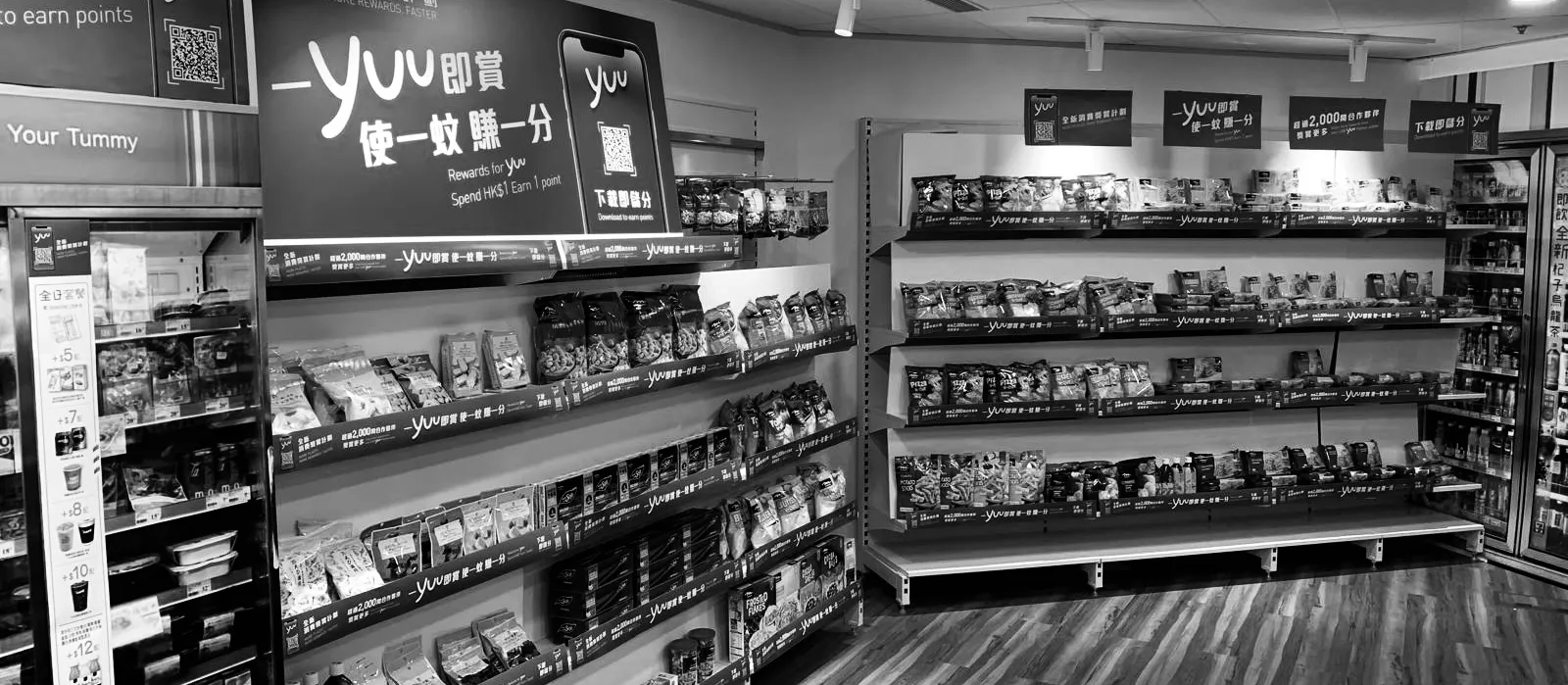
We ran extensive user testing on the app, not only to gauge how customers responded to the experience but also to benchmark ourselves against competitor apps. We also went further than most - we constructed a full replica store, complete with shelving, product, and tills, to simulate the in-store environment. This allowed us to test signage, marketing displays, and POS mechanics in a realistic setting and refine them before rollout.
While not a substitute for true in-market geo-tests, these methods helped us replicate much of the expected customer journey and gave us confidence that, on day one, the customer experience would feel seamless.
Proving it — Again and Again
Whether or not you test ahead of launch, the challenge doesn’t disappear once the programme goes live. In fact, scrutiny intensifies.
There’s always pressure to demonstrate value. You can’t rely on the phenomenal lift you saw ten years ago — or even last year. You need to show lift today.
And not just once, but over and over again.
In loyalty, value unlocks value. Demonstrating impact is what gives you the right to invest further — to introduce new mechanics, to add services, and to expand your partner base. Ultimately, to move from a marketing tool to a strategic engine.
That’s the real leverage of loyalty — not just the sales it drives today, but the opportunities it opens tomorrow. It reshapes journeys, extends missions, unlocks data, and powers new revenue streams. But only if you can prove it.
That’s why attribution matters. That’s why structure matters. Above all, that’s why orientation matters.
The greatest value unlock from loyalty isn’t in just how it’s designed or measured, it’s whether the organisation is truly customer-led. Where that’s true, loyalty stops being a marketing programme and becomes a growth platform.
That vision was exactly what we presented in the Jardine House boardroom — and it won us a resounding “yes” to launch.
We were now on track to build a platform based on loyalty value. The next step was proving its worth — a subject I explore more in the article Return on Marketing Activity (ROMA)