

Follow the Crowd
Predicting Enrolment at Scale
Mark Sage - 15 min read - 18/04/2025
“The huger the mob, and the greater the apparent anarchy, the more perfect is its sway. It is the supreme Law of Unreason.
Whenever a large sample of chaotic elements are taken in hand and marshalled in the order of their magnitude, an unsuspected and most beautiful form of regularity proves to have been latent all along” — Sir Francis Galton
Englishman Sir Francis Galton — a Victorian statistician, psychologist and polymath — is well known for his invention of the Galton Board which is a ‘bead box’ whereby beads/balls are dropped from the top and bounce in a seemingly random way off pegs, as they fall to then collect across the bottom in bins. Whilst it may be expected that they would indeed fall randomly, they always end up falling into the pattern of a bell curve.
This essentially demonstrated the ‘Law of Unreason’ to which Galton speaks and whilst you couldn’t say with certainty where a single bead or ball may land, given a large enough sample, you could begin to predict the overall pattern of behaviour.
It was this ‘beautiful form of regularity’ in what may seem a chaotically large sample that we relied on to predict the enrolment curve for yuu Rewards.
Many of us on the team had worked on loyalty programmes before and had seen how enrolment works. What’s interesting is that within a given base, customer behaviours can actually be predicted quite well.
Despite the passage of time, the progression of technology and changes in consumer culture — yuu Rewards followed the same pattern we’d seen before.
As Galton observed, the larger the crowd the more regular it performs — and grocery led coalition programmes are quite naturally large. They seek to hit an entire population and from this recruit an audience that is typically 50%+ of households.
This large audience requires a large marketing campaign to ensure we get the level of visibility and awareness we want and to maximise programme growth. In our initial marketing planning we’d designed for 99.5% brand awareness (although this was dialled back a little) but overall, we were aiming for pretty much everyone in Hong Kong to know about yuu Rewards.
The question at hand though was, with all this marketing, when exactly would these customers enrol?
Like any new product of service, there is an adoption curve with ‘early adopters’ coming in first who are happy to take part in something new. At the other end there are the laggards who take their time to evaluate it — they need more validation, more awareness, more calls to action. This means that the way that people come into the programme is on a curve.
Predicting this adoption curve and when enrolment will take place is critical to both understanding the success (or otherwise) of the launch marketing campaign, as well as being able to predict the likely impact on the underlying systems, operations and technology.
If enrolments are below expectation, we could push further marketing activity, such as digital awareness or more dedicated in-store marketing. If enrolments are above expectations however, we may need to increase systems capabilities to handle the additional spike in demand.
How best then to predict this enrolment curve so we can balance investment across the enrolment period and manage operational costs?
Well, just as with the Galton box, it seems that no matter how many times you launch a mass loyalty programme you see the same metrics.
Obviously not in terms of the actual number of enrolments — this is heavily dependent on market penetration and other factors like purchase frequency. However, the ratios around enrolment do tend to be consistent across markets and timespans.
This means once you understand how mass programmes perform, you can use this to predict the behaviours for future programme launches.
Rate of Adoption — Decoding Behaviour
The introduction of a loyalty programme is essentially an innovation for a brand. Whether it’s a more traditional plastic card programme or a digitally focused one, it still represents something new for customers and so will be adopted by customers over a period of time.
This rate of adoption, known as this ‘Diffusion of Innovation’, is something first written about by Everett M. Rogers in his book of the same name. You may not know the name, but there is a good chance you’ve seen the diagram showing the categories of adopters — from innovators to laggards.
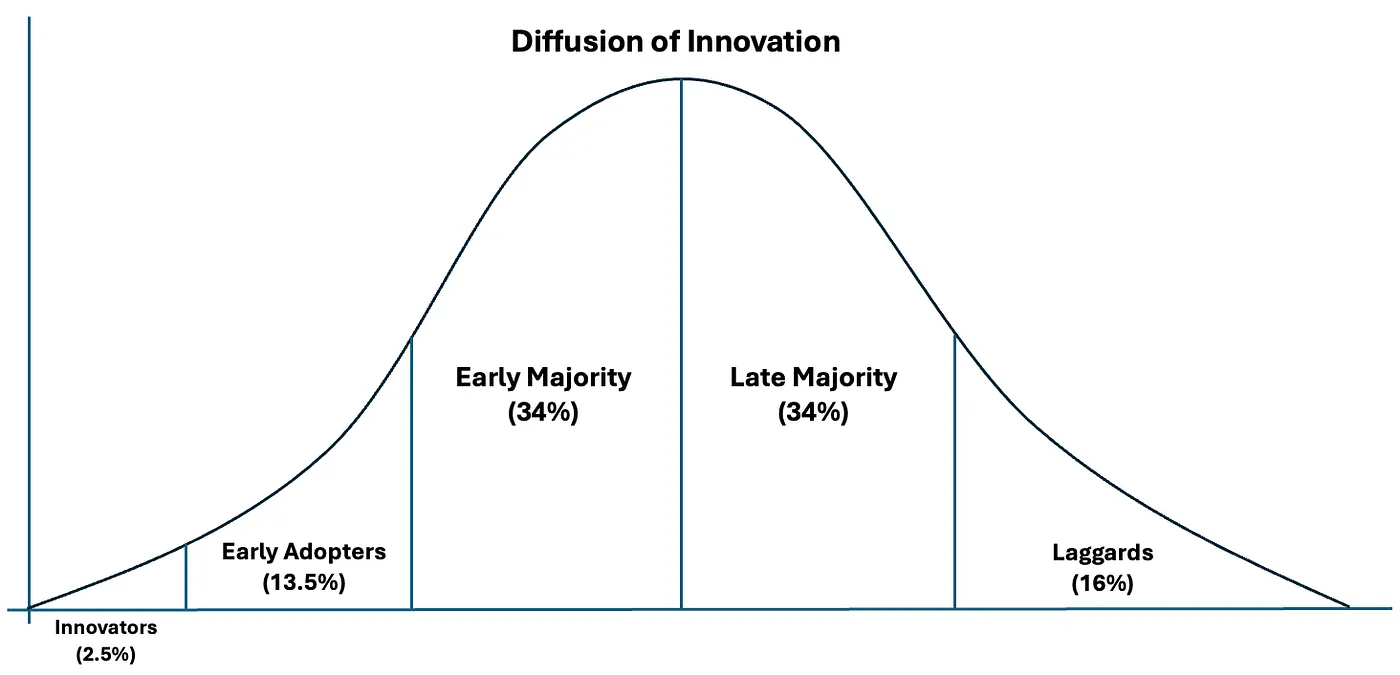
What Rogers proposed was that any audience (or crowd) follows a standard pattern of diffusion or uptake of a given innovation, with those taking it up first being the Innovators and Early Adopters and those later being the Early and Late Majority respectively.
This pattern of adoption is in part sociological, based on an individual person’s attitude to risk and innovation, as well motivational — looking at effort vs ‘cost’ of making the change.
We’ll talk more about cost later, but suffice to say that people will be weighing up the commitment and energy to participate versus what they perceive the overall benefits.
What’s interesting here though is that the size of these adoption groups is fixed within the model, but timing as to when they come onboard is flexible — for example Early Adopters are 34% of the group but when they start adopting the innovation will be highly dependent on the ‘cost’ of the decision.
Unlike physical products like DVDs or mobile phones, a loyalty programme has a relatively low cost of entry and so rate of diffusion is very quick. Not only is it quick, but for fast moving retail programmes, it’s also quite consistent.
4–40–400 Rule
Not many people get to launch a mass market, national coalition programme like Nectar or yuu Rewards — but when you’ve been involved in the launch of several of them, across different markets and different decades, you begin to see patterns. One of these patterns is the rate of adoption for enrolment.
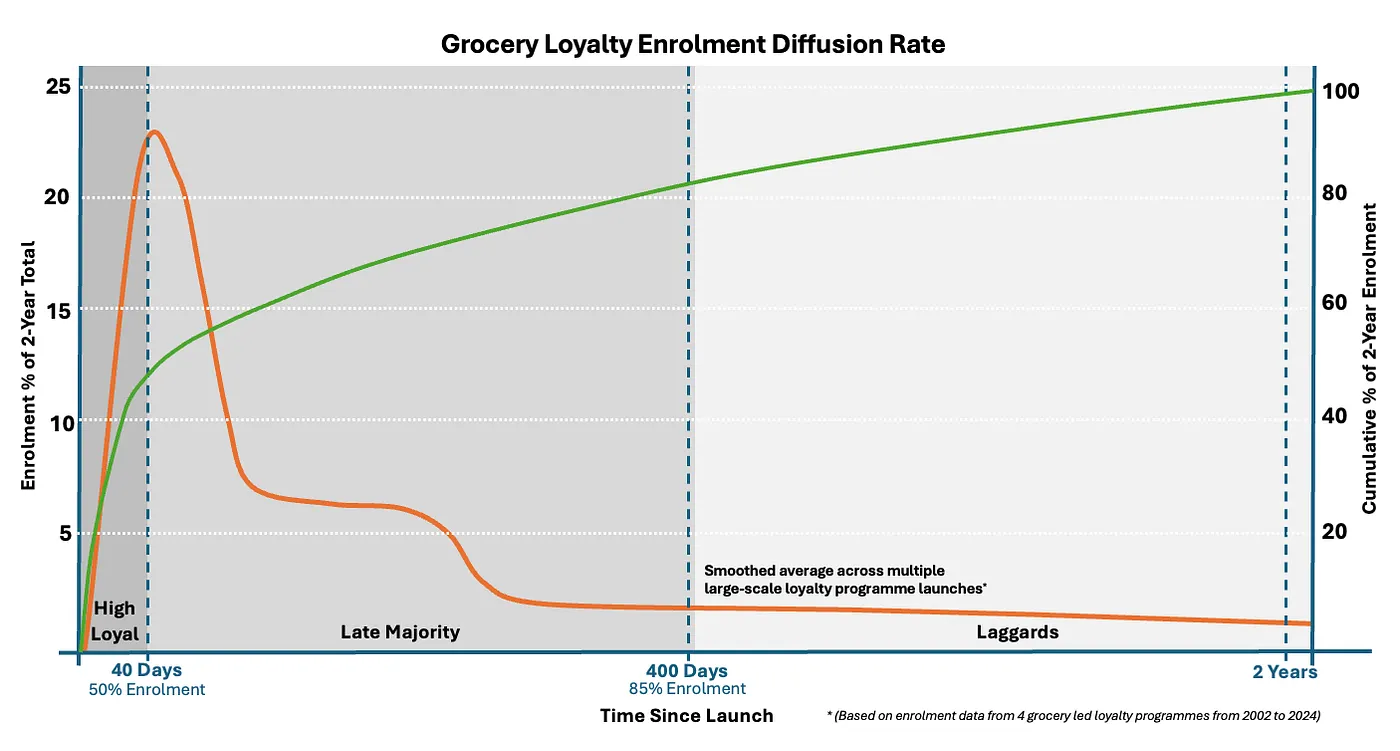
Rogers proposed five adopter categories and their associated size as a percentage of the total audience — what he didn’t include was how quickly these audiences would respond. That makes sense as this would clearly be different for every innovation; however, for fast moving retail loyalty, it’s pretty consistent and it’s something I term the 4–40–400 rule.
4 Days — This is the time it takes for the Innovators and Early Adopters (c.16% of the base) to come on-board.
40 Days — The next group of Early Majority (c. 34%) is reached in just over a month.
400 Days — The Late Majority (c. 34%) then takes just over a year. By this point we have around 85% of the base enrolled and the Laggards fill out the long tail up to the end of the second year.
So, in around 4 days you’re at about 16%, by day 40 it’s a cumulative 50% and by day 400 you have the vast majority of the loyalty base enrolled.
Now, for a couple of quick health warnings.
Firstly, this is clearly highly dependent on how well the scheme is marketed, how well it’s promoted in store, and how well your staff are trained to promote it. Nectar ran just a little slower than this in the first month, as did a couple of other schemes I’ve benchmarked. But across 5 different schemes from 5 different countries, they all start to coalesce towards 40 days and pretty much run together by day 400.
Secondly, this is based on observed behaviour across a number of large, mass, national schemes, with a grocer at the heart. The frequency of grocery is what drives this speed of diffusion and so the timing would be very different for other types of retail and other industries. Despite that, I suspect the same pattern would exist, it’ll just be on a different timing.
Another reason for this speed of diffusion though — which will be common to all programmes — is the impact of high loyals.
These customers have the most to gain with high frequency and high spending and so the loyalty programme proves very attractive. They can see the value instantly given their purchase behaviour and will be much more likely to sign-up. In addition, because they come in so regularly, they will tend to be in-store within the first few days of launch and so the penetration of this customer segment will be quick and high.
For a fast-moving sector like grocery, these customers may be coming in 2 to 3 times a week on average, especially that top 20% of high loyals who are 50% or more of your total spend.
The customers following this segment will be less loyal — lower frequency and lower overall spend — let’s call these Medium Loyal. These customers won’t be in-store as much and so it will take longer to penetrate this base overall. They are also likely to be less attracted to the proposition as their loyalty is more divided across retailers or categories. This means it will take longer for the marketing and awareness to cause a response. They’ll definitely be weighing up the ‘cost’ of joining — balancing the effort to participate with the likely reward.
They are still a key customer segment though, especially with the opportunity for category and spend growth, but just a harder audience to reach quickly.
The final segment are the Low Loyals. They will be coming in with much less frequency and so the messaging and the loyalty offer will have less overall appeal. For this audience the launch messaging may have created awareness, but it won’t be enough to drive a visit or sign-up. Instead, it’ll be the always on in-store prompts that eventually convert them.
This rate of diffusion had been observed on a number of mass loyalty programmes prior to us launching yuu and so it was something we used to map out the overall enrolment flow for yuu Rewards before launch to help us maximise both operational and marketing effectiveness.
In the end, we were we a little ahead of the projections on yuu Rewards within the first few weeks, but by month 2, the programme settled back into the same curve we’d seen on previous programmes with enrolment continuing to go up, but with the pace flattening as the weeks went by.
Although expected, it was still fascinating to see how the yuu Rewards enrolment curve mirrored other programme launches like the Nectar UK launch almost to the percentage point, month by month — a programme which had launched 20 years previously, in a different market and in an offline world. For yuu Singapore, the same metrics were seen again despite a difference in market share.
Whilst the rate of enrolment in terms of 4–40–400 is fairly consistent across these mass loyalty programmes, what is more variable and harder to estimate is the overall size of the audience we’re looking at recruiting from.
Using the example of the Galton box, the balls will always fall into the pattern of a bell curve, but the number of balls used can be varied with little impact on the result.
What this means for loyalty is that whilst we know that by day 40 we’ll see around 40–50% of Year 2 membership, we actually don’t know how many members will be in the total pool.
For that, we need to look elsewhere.
Estimating member volumes
When Nectar launched in 2002, they announced that they’d recruited 11m people into the programme within the first few months. For context, Tesco reported 10m members in their 2003 annual report, 8 years after launch — so this was a strong number for Nectar, and one contested a little in the press at the time.
The challenge though isn’t so much what the value is, but what the value will be.
Nectar famously had a meltdown of its website in the first few weeks of launch, clearly underestimating the volumes they’d receive. So knowing not only the rate of diffusion, but also the volume of members going through it, is critical to managing a robust programme launch.
But how do you estimate your membership volumes beforehand?
While early enrolment can be modelled with adoption curves like the 4–40–400 Rule, the ultimate size of a loyalty programme is constrained by something more fundamental — your addressable shopper base.
You may want to get 50% of the population in your programme — but wanting and doing are very separate things.
Turns out though, there is a little science that underpins this, and we can look to NBD Dirichlet theory for guidance. Whilst this model is most commonly used to describe buying behaviour (and famously underpins the book ‘How Brands Grow’), it can also provide a framework to estimate the ceiling of loyalty programme enrolment.
At its most simple level, your enrolment within a given period can’t exceed your market penetration.
That penetration is a measure of customers who have shopped at least once with you in that time, out of the total customers shopping in that market/category during the same period.
Given recruitment for loyalty is within your customers, then logically, you can’t recruit more members than this — it’s like a cap on your total membership base.
Loyalty acquisition is basically proportional to market penetration.
You could theoretically drive awareness of the program outside of your customer base and sign these people up too — but reality doesn’t work like that and 90%+ of sign-ups happen in-store with customers who are shopping with you.
So, market penetration is a key number here — but it can also be a hard number to get hold of.
Market share on the other hand, tends to be much more accessible.
Measuring your revenue as a percentage of the total revenue for all brands in that market, over a specific period, is information that’s typically published in annual reports, and so easier to consolidate.
The question then is how to use market share (a measure of spend) to calculate market penetration (a measure of customers).
Share of Category Requirements (SCR) can help here. It’s a measure of your customers spend with you as a percentage of their total spend for all brands in your category. (e.g. For all customers shopping in Sainsburys last year, what % of their total grocery spend was for Sainsburys).
With this metric, we can convert market share (your total spend in the category), to market penetration (your share of customers)
Penetration = Market Share / Share of Category Requirements
Great in principle, but still not an easy metric to get.
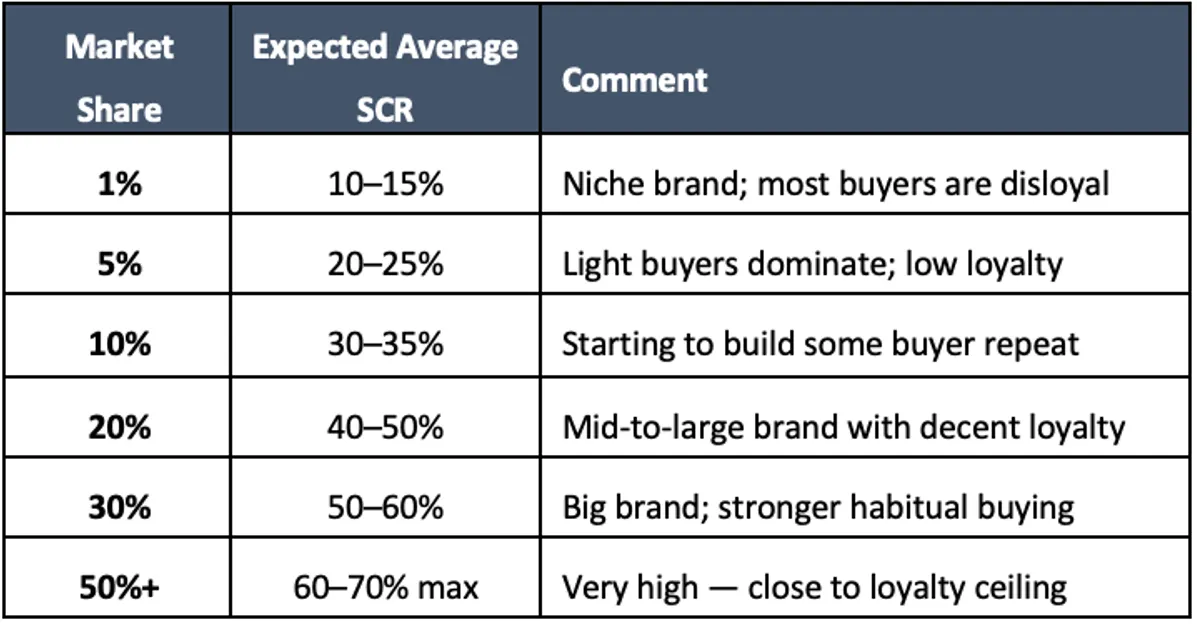
However, we can cheat a little bit here — and this is where NBD-Dirichlet theory can help. In Dirichlet theory, SCR is a function of market share, meaning, the more share you have, the more loyal your buyers tend to be (and hence the higher your SCR!). Plus, as Byron Sharp points out repeatedly, this relationship is surprisingly predictable and patterned, not random.
Larger brands always have more loyal buyers — not because they “retain” better, but because buyer behaviour naturally coalesces as brand size grows.
Smaller brands are inherently less loyal — they are bought by people who also buy from bigger brands.
SCR does not vary wildly between buyers — the average is stable, and highly predictable once you know market share.
This is pretty much the Double Jeopardy Law in action — smaller brands suffer twice — fewer buyers, and those buyers are less loyal.
This predictability though works to our advantage and allows us to create a ‘cheat sheet’ for SCR based on market share, as shown in the following table.
So back to the Sainsburys Nectar example we discussed earlier. In December 2002, just 3 months after launch, they announced they had 11m members. Sainsbury’s market share at the time of the Nectar launch was around 17.5% with food sales of about £13.3bn.
The 11m enrolments raised questions in the press, with some feeling it was likely overstated — so let’s see where the data would lead us.
Using the Dirichlet average SCR, their market share would indicate an SCR of around 35–40%, leading us to a penetration of the grocery shopping population of around 44%
i.e. (Estimated Penetration = 17.5% Market Share ÷ 40% SCR = 43.75%).
The grocery shopping population is pretty much every adult in the UK — so in 2002, that was about 50.4m — which at 44% estimated penetration is 22.05m people who likely shopped in Sainsburys that year at least once.
Not everyone will participate due to their infrequency of purchase or just apathy to loyalty — so let’s assume a loyalty enrolment rate of around 60%. This brings us to about 13.3m potential members recruited within 12 months from Sainsburys. If you want to know what your first year looks like, that’s pretty much it.
Calculating the 2 year enrolment number means we need to account for customer churn and new customer entry over time. Because of rotating light buyers, a brand’s 2-year penetration is typically higher than its 1-year number. Dirichlet norms suggest you’ll see 10–20% more unique customers over 2 years compared to a single year.
This then shifts our penetration for Sainsburys to around 53% — which lands us on a 2 year membership enrolment estimate of 16m.
i.e. (50.4m population * (44% SCR * 1.2) * 60% enrolment = 16m)
In reality, their 2 year enrolment was closer 18m, but that was for the total coalition (so more partners than just Sainsburys) — which means we’re definitely in the ball park.
So we have our estimated 2-year member enrolment. Now back to Rogers Diffusion and the 4–40–400 Rule.
At 40 Days, we should have already seen the Early Adopters (c. 16%) and the Early Majority (c. 34%) — giving us 50% of the 2-year membership. That’s around 7.9m members based on the previous 2-year membership calculation.
In fact, the number was just over 8m — and by the Dec 2002, just 3 months later, it was about 10.8m.
The 11m claim in the press was pretty accurate, and amazingly, also very much in line with their market share of 17.5% and with the rate of diffusion we’d expect.
Overall, in Nectar UK we saw a higher level of enrolments as a percentage of transactions than we saw on yuu, but this is likely also a function of the plastic card — it’s easy to take one and just as easy to take another if you’ve left it at home. So, whilst the ratios are the same for 4–40–400, the enrolment volumes were slightly higher as a percentage of purchase transactions. Active accounts on the other hand would be a whole different story.
This pattern of enrolment is something that I’ve seen repeated on multiple loyalty programmes and it’s uncanny how closely each programme matches the curve.
It also uncovers what can be an uncomfortable truth — a loyalty programme doesn’t really bring in new customers. It makes your existing customers more valued and more valuable.
That’s not to say that it won’t encourage occasional shoppers to become regular shoppers. But, if the aim is to take your competitors best customers away, the loyalty programme just won’t do that.
Instead, the purpose of the programme is to identify your own customers — those who are already coming into store — and this is why the enrolment curve is so tightly linked to your market penetration.
Mapping the enrolment curve
Back to Galton then and his ‘Law of Unreason’. We couldn’t predict how a single customer walking into the store would react to the new programme, but we could use past experience to predict how a ‘huge crowd’ of people would react.
Veracity — Rogers gives us the who and the how much
Velocity — The 4–40–400 rule tells us when
Volume — Your market penetration determines how many and NBD Dirichlet can help uncover it
So, armed with market penetration and the model of past behaviours, we could estimate enrolments in that first week and first month — our Early Majority.
We were also pretty confident that around 50% of the full 2 Year enrolment would be captured by the end of that month so the Early Majority would be in and engaged within just 40 days from launch.
Using these data points and others along the adoption curve to map out the volume and velocity of enrolment, we had a solid prediction of expected customer behaviour that could map expected demand operationally for customer service and systems capacity.
It also gave us a barometer to success — something we could track to make sure the programme was landing well, the marketing working hard, and the expectations meeting previous norms.
So how did we do?
Well at week 1 we hit 1m members. Month 1 we hit 2m. Enrolments were matching the curve we’d predicted (and were just slightly ahead). By the end of year 2 we hit 4m members.
All in all — we did pretty well.
In fact, yuu Rewards has become one the most successful coalition loyalty programmes ever, reaching an estimated 67% of the total adult population of Hong Kong.
Like the Galton box, you may not be able to predict the path of each individual bead or customer — but the shape of the curve is inevitable. And that’s the real power of launching at scale.
You don’t need to guess what each customer will do, you just need to follow the crowd.