
Loyalty Is Not an Emotion -
It’s a Memory System.
Why repeat choice is built on recognition, achievement, and memory — not love.
Mark Sage - 12 min read - 16/12/2025
A few years ago, I was travelling long-haul, bouncing back and forth between the UK and Australia more often than I care to remember. On one particular flight, as dinner arrived, I noticed a small handwritten note on my tray. It simply welcomed me back on board.
It was a tiny gesture. It cost almost nothing. But it gave me a warm feeling — that quiet sense of being recognised. Someone had noticed me.
We all have stories like this. A free coffee. An unexpected upgrade. A handwritten note. Moments that feel warm, human and memorable. These anecdotes travel far on social channels and conference stages because they capture what people instinctively believe loyalty should be.
Adam Posner calls these “Joyalty Moments” — tiny bursts of joy that light up a person’s day. His own ritual of gifting free coffees expresses this beautifully, showing authentic generosity powered by kindness rather than algorithms. People respond to these stories because they intuitively understand something important — emotion matters in loyalty.
But here’s the uncomfortable truth.
Loyalty can’t run on serendipity.
A programme built on chance can create stories, but it can’t deliver change. Loyalty requires something far more disciplined — systematic, scalable behavioural design.
For some, that may sound bold. The concept of ‘Surprise & Delight’ is almost always in the top five ideas on any white board for a new loyalty programme (right next to “Money can’t buy”). Surely, creating moments of delight for customers will make them happier, more loyal, and more likely to tell their friends. All that is true.
But here’s the rub.
Gamblers keep gambling because there is a goal. They know a payout will come; the only unknown is when. Gamers keep “grinding” because they know what they’re working toward; the uncertainty is timing, not purpose. Behaviour is driven by reinforcement. For a behaviour to repeat, the brain must see a link between action and outcome.
If the reward is random and unconnected to what the customer did, it may feel nice, but it won’t shape future behaviour. There is no goal, and therefore no reinforcement loop.
It may feel good as a marketer to be generous, to imagine the emotional impact. But unless the programme has the budget and scale to deliver surprises to everyone, you end up with a handful of happy anecdotes and little benefit for the wider base. And if you do extend it to everyone, the surprise evaporates almost instantly.
Waitrose learned this the hard way.
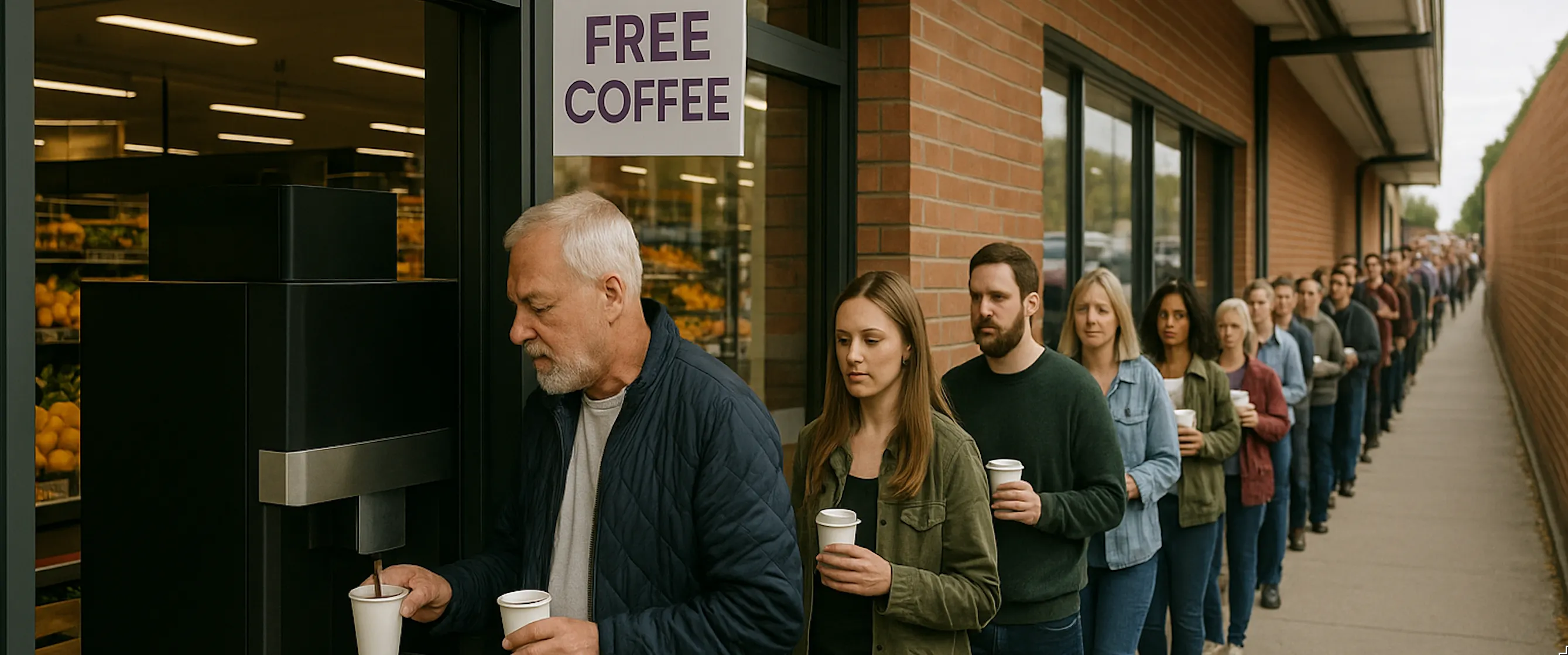
Their free-coffee perk began as a clever premium benefit for myWaitrose members. Giving them all a free barista-style drink simply for holding a loyalty card. Over time it became wildly popular — so much so that queues formed, machines clogged, and loyal shoppers complained that the offer was being abused by people not buying anything (and in likely hushed tones… not by ‘real’ Waitrose customers). Some even said the quiet part out loud, with the Guardian reporting complaints that it brought in the “wrong type of customer”, who was enjoying benefits meant to delight the “right” ones.
To combat this, they changed the rules so a purchase was required before the drink could be redeemed, acknowledging the “freeloader” problem. Cue another wave of complaints — this time from loyalists who wanted to drink their coffee while shopping but now had to juggle it at the car.
What began as a genuine surprise & delight benefit had quietly hardened into an expected entitlement. The mistake wasn’t offering free coffee; it was assuming that a surprise can remain a surprise once it becomes universal. Delight lives in contrast, and the moment it becomes routine, it disappears. That is loyalty’s paradox — the very act of scaling a gesture destroys the quality that made it special, yet anything unscalable rarely delivers meaningful incremental impact.
Pret took a different tack.
Instead of giving everyone a free coffee, they empowered baristas to surprise customers at their discretion. On paper, that sounds sensible. Costs are limited, staff know their regulars, and it creates emotional stories. In fact, their Chief Executive at the time, Clive Schlee, said:
“We looked at loyalty cards but we didn’t want to spend all that money […] instead the staff have to give away a certain number of hot drinks and food every week”.
Interesting, except for one flaw — human bias.
Schlee even acknowledged this as if it were a feature, not a bug —
“They will decide ‘I like the person on the bicycle’ or ‘I like the guy in that tie’ or ‘I fancy that girl or that boy’. It’s a nice, different way of doing it”.
When decision-making isn’t systemised or measured, you lose control. As you’d expect, free drinks disproportionately went to the familiar, the friendly, and — far too often — the attractive. The result was a mechanic that alienated those never chosen and failed to reward true loyalty. Scattergun surprises create stories, not systems, and at worst, they undermine fairness.
If loyalty is about habit and reinforcement, the path forward isn’t random delight; it’s structured, scalable mechanics that link effort to reward, designed to delight every customer.
This is not to say emotion doesn’t matter. It does — but not because of generosity. Emotion matters because it is through emotion that memories are formed.
Without emotion, experiences pass through unnoticed and are quickly forgotten. But the emotion that builds loyalty is not the soft warmth of being liked or cared for; it is the sharper feeling of recognition. The sense that this brand noticed me, this effort counted, I made progress. These are the emotions that anchor experiences in memory.
Mechanics. Marketing. Memories.
In loyalty, the strongest memories are not forged through generosity, but through achievement — moments where customers feel they have earned something, unlocked something, or moved forward. This is what truly drives lift.
As Nunes and Drèze showed with their Endowed Progress work, behaviouronly changes when customers feel they’ve done something to move forward — that they’ve earned a step, crossed a threshold, or unlocked progress. It is that moment of recognising achievement that produces the real emotional payoff — a pleasant surprise, the same feeling you get when you suddenly realise you’ve beaten a personal best. It’s not the reward itself that matters, but the internal jolt of progress. That is the moment that forms a memory.
When those memories sit inside a behavioural system — reinforced by mechanics and framed by marketing — they become the engine that drives future action. A personalised, scalable engine designed to supercharge those “Joyalty” moments.
Tim Mason, former CMO of Tesco, once remarked to me that when customers redeemed their Clubcard value on something meaningful — like a family holiday in France — they often came back stronger. They shopped more. They spent more. That sense of achievement, earned through everyday shopping, didn’t just feel good in the moment; it reshaped future behaviour.
When most people think of loyalty marketing, they think of points. They are the visible layer — the currency that signals value and connects customers to baskets. But customers rarely think about points at the moment of choice. Mental availability and Category Entry Points (CEPs) offer a more reliable explanation. People buy from the brands that come to mind, easily and naturally, when a need arises.
And that coming to mind tends to derive from prior experiences; something that the book How Brands Grow — Part 2, highlights when it describes CEPs as “the retrieval cues buyers use to access their memories”.
This does not mean that loyalty has nothing to do with the buying decision however — as this is where memory comes into play.
Loyalty is an outcome — a repeat choice in the face of alternatives. To earn that choice, a brand needs to be recalled quickly and positively at the moment of intention.
In other words, a brand needs to live as a memory, aligned to a need — and memories don’t form by accident.
Customers remember their experiences; whether the product they wanted was in stock, whether the price felt fair, whether the item lasted or tasted good. A bad experience becomes a warning sign; a good experience becomes an invitation to return.
Equally, customers remember the feel of the brand. It’s distinctive assets and brand marketing. Whether the store was welcoming and the staff helpful. Whether the visit felt smooth and frictionless. These experiences layer together, against different CEPs, shaping whether the brand rises to the top of the list next time. This is where loyalty marketing plays a distinctive role.
Loyalty is, at its core, a memory-making marketing discipline.
Loyalty doesn’t live in the transaction; it lives in what remains after the transaction is forgotten. Memory is the residue of experience, and that residue is what gets a brand chosen again.
The authors of How Brands Grow land this point strongly when they say :-
“A key role of marketing activity is to shape buyer memories to the brands advantage”, and “one of the best empirical-laws about brand associations [is that] a brand is more likely to evoke associations in its users than in its non-users”.
In other words, marketing’s job is to shape memory to a brand’s advantage — and memory is strongest among those who already use the brand. Loyalty doesn’t contradict this logic; it operationalises it.
The role then of marketing in a loyalty context is to reinforce the feeling that choosing this brand was worthwhile, meaningful or even enjoyable.
Whether we realise it or not, we do this by building Memories — within a defined programme design and through well-structured loyalty Mechanics and Marketing.
These memories, formed through the feeling of achievement, give existing brand users the pleasant lift that comes when something feels earned, unlocked or completed.
It’s in these moments that we lay down the reasons to come back.
As an industry, we tend to dance around this idea. We talk about Surprise & Delight or Emotional Loyalty. We invent labels like “fans” or “advocates.” We measure recommendation intent as if loyalty were a friendship test.
But much of that is noise.
We become a repeat choice not because customers love us in an abstract sense, but because we have high mental availability against the key CEPs. Put simply, we come to mind at the right moment.
Again, How Brands Grow provides some useful insights and how best to do this too, saying
“We can use marketing activity to influence and accelerate the process [of building links between brands and CEPs] on the brands behalf [..] outside of normal buying patterns” as it’s an “ongoing battle for memory freshness”, so “to grow, you need to build freshness across category buyers and CEPs”
In short, you need to market to your buyers about why and when you matter. And loyalty marketing is a fantastic way to do just that.
Our job then as loyalty marketers — and to be frank, as marketers in general — is to build the mechanisms that build those memories. Whether through brand marketing, store experience, product innovation, or — yes — a well-designed loyalty programme, our work is to create and reinforce the memories that drive repeat behaviour.
And the framework for doing this within loyalty is simple —
Mechanics, Marketing and Memories — the 3Ms of Loyalty.
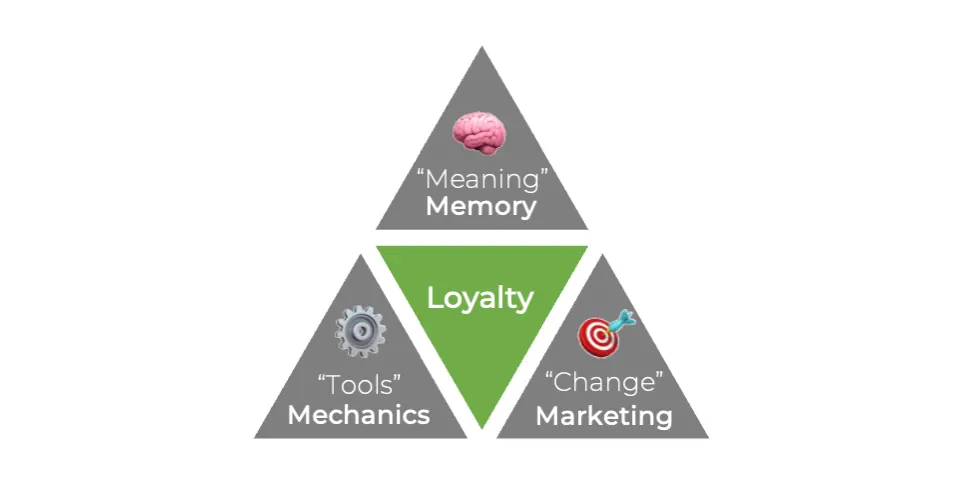
Mechanics — Tools to capture behaviours and incentivise progression: points, challenges, tiers, rewards.
Marketing — Where change is framed and reinforced; highlighting value, reminding of progression, building brand.
Memory — Where it all becomes meaning: not transactional like a sales promotion, but a ‘pleasant experience’ built in layers.
When designing loyalty programmes, most people start with Mechanics — getting the earn and burn rules in place. Some will go on to think about the Marketing, implementing the basic journeys around CRM. Not many though think first about Memories. Yet memories power motivation, so that’s where we should start.
In loyalty, memory is formed by micro moments. Not simply the big, flashy reward, which may sit far in the future. Instead, every interaction, for every customer, at every touchpoint. This is magic at scale.
Looking again at the concept of ‘Surprise & Delight’, you can see the distinction. Surprise & delight has been a loyalty buzzword for years because it sounds nice and makes for great socials. But it is generally random, unmeasured, unscalable, and rarely tied to value. Pret’s barista-led freebies were delightful in theory but inconsistent and unprovable in practice — which is likely why Pret went on to launch a loyalty programme five years later.
Micro moments, by contrast, are deliberate, costed, measurable and designed to reinforce progress. They are small wins that accumulate into emotional memory — helping to build freshness across category buyers.
We designed yuu Rewards around this insight. Confetti animations on redemption transformed a functional process into a celebration of achievement. Redemption design ensured that, on average, members redeemed around two and a half days before their next shop, and their subsequent basket grew by twenty to thirty percent. Every basket earn was celebrated with a push notification. Every stamp unlocked with an in-app animation. Every cashier asking if you’re a member. Every personalised offer highlighted to you and reminded. And yes, every free coffee unlocked based on your personal achievement — giving that feeling of a ‘pleasant surprise’.
These were not accidents.
The incremental lift we saw year on year was measurable and meaningful.
They were micro moments — small, intentional emotional peaks designed to reinforce behaviour and convert progress into memory.
Movement, not just moments
Years earlier, in Spain, we built a very different loyalty model for DHL that at first glance looked like the most elegant form of surprise & delight. Customers never earned visible points. There was no programme interface, no tiers, no explicit rewards. Behind the scenes, however, we tracked each customer’s spend and reserved a proportion into an unseen pool. We termed this “implicit loyalty”.
When we detected lapsing behaviour — say a customer who reliably shipped twenty kilograms to Paris each week suddenly dropping — we triggered a tailored stretch offer such as “ship your usual twenty kilograms next week and receive a high-value reward”. Sometimes that reward was a radio alarm clock, other times it was a television or another premium item — the point was that it was proportional to the customer’s historic value.
To the customer, it felt magical. To us, it was economically precise.
If the customer never lapsed, the reward was never paid. Breakage made the model efficient. The generosity was engineered, not accidental. And yet, even though this programme delivered scalable “surprise,” it still wasn’t loyalty in a full behavioural sense. It protected value; it did not grow it.
That distinction is crucial. Memories matter, but only when they exist inside a system that uses them to change behaviour.
Surprise & delight can create anecdotes, but micro moments create memories, and mechanics create movement. Marketing frames that movement so customers understand its meaning. Only when all three align do we see incrementality through more visits, more baskets, and more share-of-category than a customer would otherwise have given.
It also doesn’t need to have scale to be scalable. For many airlines, the seat upgrade process is not random. The airline knows the value of that seat, and they also know the value of their frequent flyers. Allocation is very much designed to drive incrementality through memory. You feel great for getting it, you tell your friends, you experience the product — encouraging you to fly more and hopefully fly flat! Critically though, none of this was random.
Likewise, when I was at DFS, we gave our top tier members a seasonal gift — designed for them. This wasn’t scaled across the whole member base, but it was costed into that tier, and we measured the uplift. Creating memories often creates conversations, and at DFS, those gifts were the perfect way to re-engage top-tier members through clienteling. Human to human, but powered by systems, data and scale.
There remains a place for mechanics like ‘Surprise & Delight’. These efforts can generate positive stories and social content, feeding the wider brand narrative. Tied to membership, they can elevate the programme story for acquisition and reinforce the idea of being a member rather than just a customer. But let’s not confuse PR with loyalty, or promotions with programmes. These are brand campaigns wearing a loyalty badge. They provide visibility and narrative, not the reinforcement loops that change behaviour.
Loyalty, at its core, is not built on single moments of magic.
It is built on systems that manufacture meaningful moments — intentionally, repeatedly, and at scale. That is how memories become part of the infrastructure, and how that infrastructure becomes incrementality.
That is the work of loyalty — and it’s where the 3Ms of Loyalty come alive.