
Known Buyer Bias
Limiting brand growth by optimising for what we see, not what we don't.
Mark Sage - 12 min read - 01/03/2026
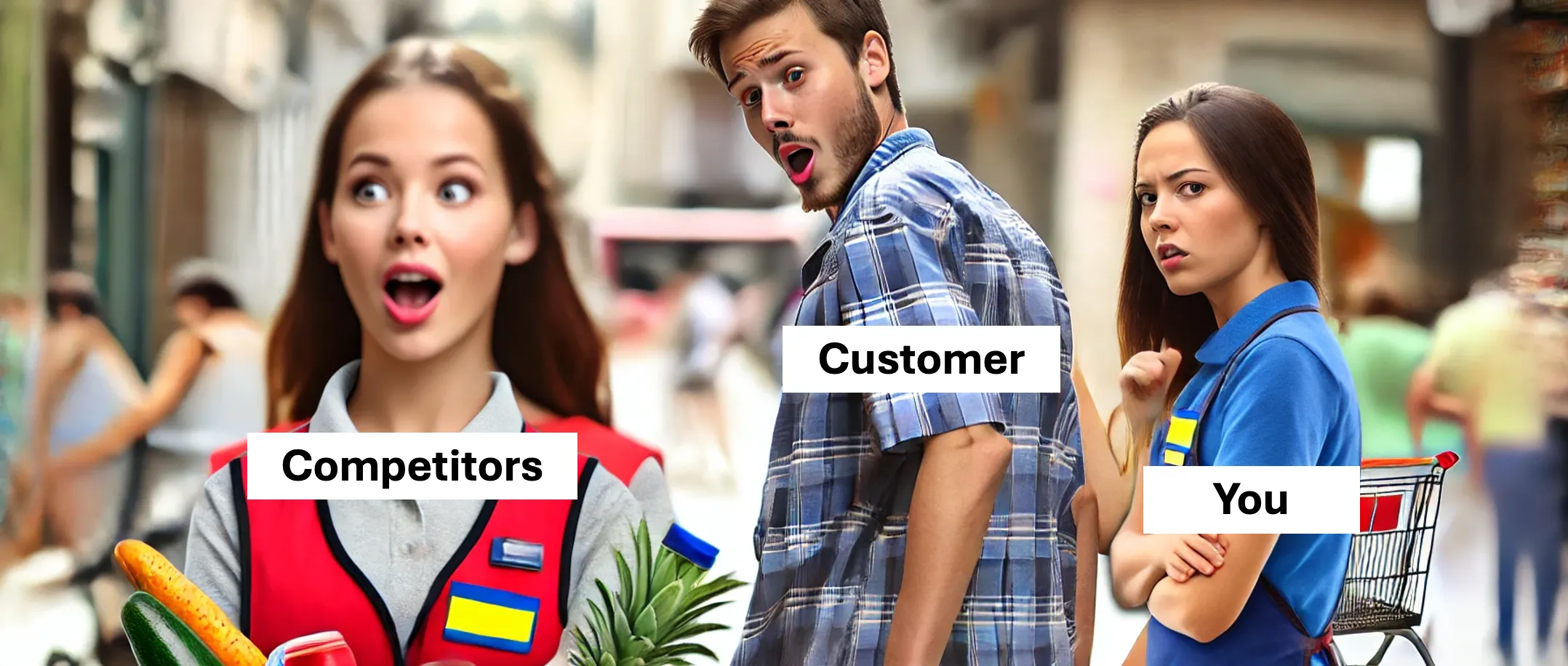
Marketers have spent years refining their ability to target the right customers, at the right time, with the right message. But the more precise we get, the more we fall into a trap — the Known Buyer Bias — focusing only on the customers (and behaviours) we already have, while missing the real growth opportunities.
Instead of expanding our reach, we’re just optimising for what’s already working. And that can be a dangerous mistake.
During World War II, the allies had a similar problem. Too many bombers were being shot down before returning to base but reinforcing these bombers to make them more bulletproof would add weight, slowing them down and reducing range. The instinct was to map bullet holes on returning aircraft, reinforcing those areas while keeping the planes light.
But what about the planes that didn’t make it back?
In all likelihood, they got hit somewhere else, and that hit was clearly fatal. This was the question that mathematician Abraham Wald asked, and it’s what helped the allies to ultimately better protect their planes.
Wald realised the real vulnerabilities weren’t where the bullet holes were, but where they weren’t. And marketers fall into the same trap — reinforcing patterns in the data we have, while missing the bigger opportunity in the gaps.
Marketing tends to optimise for what’s visible — customers who shop, click ads, or redeem offers. These are the behaviours we can measure, so they become our focus. But what about the customers who never convert? The ones spending elsewhere, the purchases we never capture?
It’s easy to assume that the patterns we see define the whole market, but that’s not true. We aren’t seeing the full picture — just the part that survived.
This is where the problem goes deeper.
We can end up mistaking what we can measure for the whole opportunity, meaning we reinforce the same behaviours over and over. Believing they represent total market demand, while completely missing the customers and missions we don’t see.
This raises an important question: Is our reliance on first-party data helping us grow — or is it holding us back?
Precision marketing feels efficient, but it often just means selling to the same people more efficiently. Instead of creating new sales, we’re just uncovering the ones we were already going to get.
If we knew exactly when a customer would shop — their next visit, next purchase — would we still send them a discount? If they were coming in anyway, surely we’d just be giving away margin.
And yet, we do this all the time.
We’re looking at the “ones that came back”, at the baskets we captured — and we’re assuming these patterns define the whole market for that customer.
However, as previously discussed, a grocery customer is typically giving less than half of their purchase behaviour to a single brand, so we don’t have the complete picture, and we risk assuming customers are more loyal than they are.
There is also a challenge of efficiency vs. incrementality.
With the one-to-one marketing goal, even with that incomplete data view, we tend to use it to predict when customers are likely to shop next. Sending them relevant offers to further ‘seal the deal’ and guarantee conversion, or maybe waiting a little longer to reel in that ‘missed purchase’ and recover the customer.
But here’s the paradox. The better we get with this activity — the more targeted and precise it becomes — then the more we’re basically selling to customers who were likely to come in anyway.
On the other hand, we’re not targeting the gaps.
By assuming our incomplete picture is actually complete, we ignore the opportunities to grab a sale that was never actually intended to be ours; with our systems just optimising within their own dataset, reinforcing this loyalty illusion.
This behaviour can be defined as a distinct cognitive bias in marketing, something that can be termed the Known Buyer Bias.
This Known Buyer Bias is when marketers mistake what they can measure for the full market opportunity. Optimising for customers we already have, reinforcing behaviours we can track, while completely missing who else could be buying from us or wider buying missions.
This results in inefficient targeting, reduced incrementality, and an overestimation of customer value.
Let’s consider a real-world example of Known Buyer Bias in action.
Imagine we analyse a known customer’s purchase pattern and see that they shop with us every two weeks. Our system tracks this, and when they miss their usual cycle — say, three weeks pass without a visit — we trigger a reactivation campaign.
The logic seems sound: send them a discount, bring them back, retain the value. At best, we assume we’ve “saved” that customer.
But here’s what we didn’t see.
What if, in the previous weeks — they were shopping every three days at a competitor?
Our focus on what we could track — their two-week shopping pattern — meant we completely missed the bigger picture, the missing missions. Instead of addressing why they were splitting their spend — and winning their more frequent purchases — we just reinforced their existing low-commitment pattern with us.
This is the danger of optimising within a closed loop. We react to what’s visible — the temporary absence — without realising the larger spending behaviour we never captured.
It’s not just a loyalty marketing issue either.
The Known Buyer Bias also extends into Performance Marketing, as this has increasingly become data driven and so is equally susceptible to this cognitive bias.
We’ll circle back to loyalty marketing later, but it’s worth spending a little time on the impact of the Known Buyer Bias within Performance Marketing to get some additional learnings.
Back in 2016, Meta (then Facebook) published an article entitled “Reach Matters: Driving Business Results at Scale” that looked at research they’d carried out on how targeting for reach compares to targeting for conversion.
Their research found that broad-reach campaigns outperformed highly targeted ones. Essentially the analysis showed that the top 25% of campaigns (those with the highest reach) were able to impact three times as many people compared to lower-reach campaigns; and they did this at 10% less cost per person reached. When they compared the top and bottom 25% of campaigns in terms of reach, the campaigns in the top quartile drove 139% more in incremental sales.
Even P&G — one of the world’s largest advertisers — recognised the problem. As Marc S. Pritchard, then Chief Brand Officer admitted at the time, “We targeted too much, and we went too narrow… now we’re looking at how to get the most reach but also the right precision.”
Eight years later, nothing has changed. A 2024 PACE study found broad targeting was still 50% more effective, no matter the budget.
And yet, marketers keep over-targeting anyway. Why? Because of the Known Buyer Bias. We’re not optimising for growth, we’re just doubling down on the customers we already know
This is a key dilemma for marketers as it intuitively feels right that being able to send ‘the right messages at the right time to the right person’ is going to be the most efficient way to do marketing. Why waste a consumer’s attention on a message if we don’t think they’ll respond, and more importantly, why pay for it!
Surely thats the best approach?
Maybe not if the Facebook results are to be believed — but is this just Facebook? Does Spotify do better?
Spotify has an ads solution for listeners on their ‘free’ service with over 400m people tuning in. So how did that perform with reach versus targeting?
In a study entitled “Overwhelming Targeting Options: Selecting Audience Segments for Online Advertising”, that looked at this question on Spotify, they found that around half of the available audience segments would need CTR rates to more than double to compare to non-targeting — something they point out pretty much never happens.
Targeting on its own then is no guarantee of success — yet we’re doing more and more of it.
The shift of marketing budgets to performance marketing (essentially targeting for conversion) is still increasing, with 70% of marketers reportedlysaying they were looking to increase budgets towards performance in 2024.
Why is this? Well, it really comes down to two things.
Firstly, that Known Buyer Bias which gives us over-confidence in the data. We tend to feel that because we have data on a customer (or prospect), we’re automatically going to be more efficient and get greater returns. This leads us to focus more on the bullet holes and less on the gaps.
Secondly, because it’s much easier to measure performance (‘we can see the actual holes from the bullets’) — through impressions, clicks and sales, and we then jump to conclusions. We take metrics like ROAS and feel that the last click truly generated an incremental sale — and that’s where we reinforce. We start spending more and more. Something WARC describes as ‘the doom loop’ in their report entitled ‘The Multiplier Effect’.
That report goes on to show how advertising should really work, saying it should support: -
Current demand — Nudge people who are actively shopping in a category toward purchasing by reminding them of reasons to buy and connecting them with places they can make a purchase.
Future demand — Build favourable and relevant associations among potential category buyers so that, when they do come into the market, the brand comes to mind easily
And to be clear, they define advertising as “cover[ing] all forms of marketing communications. In a 4Ps model, it is Promotion” — so that’s direct marketing too!
The aim then is to deliver across both current and future demand — something which the report highlighted can give an improvement in total revenue ROl in the range of 25% to 100% — with the median uplift coming in at 90%. And something famously described as ‘the long and the short’ by Binet and Field.
So, it’s not an either all.
You need performance advertising aimed at finding and converting current demand (essentially creating physical availability to make you ‘buyable’), and you need brand led advertising and messaging aimed at building mental availability and fostering future demand.
As the WARC report puts it, “equity-led [brand] advertising can help drive sales today as well as in the future. And [..] performance advertising can reinforce the brand while operating as efficiently as possible.”
This equity led brand marketing is like the Energizer Bunny, it just “keeps going, and going, and going” (itself, a great example of brand building for the ‘long’).
Through all of this, keep in mind the previous chapter around ‘Message. Not Messenger’. With the direct marketing channels afforded by the loyalty programme, you can and should be leveraging them to support both current and future demand. Brand and performance. Long and Short.
Lets bring this back to loyalty marketing then.
Loyalty marketers have bought into the illusion that better targeting equals brand growth.
But Byron Sharp’s research proves otherwise — brands grow by acquiring more buyers, not by squeezing more out of the same ones.
Just like Performance Marketing, we can and do get growth through a focus on ‘current demand’. We can get customers to buy more, and we can get customers to come more often. But also, like performance marketing, we’ll hit that ‘performance plateau’.
Neglecting ‘future demand’ within loyalty marketing, such that we don’t focus on bringing in and bringing back ‘new customers’ and ‘new missions’ through our lighter buyers, means we’re limiting further brand growth.
Sustainable success ultimately comes from balancing performance and brand within our all our marketing (including loyalty) — investing in long-term growth while leveraging customer data-driven tactics to drive efficiency, change, and conversion. The alternative is to simply optimise ourselves into irrelevance — a short-term data win at the cost of long-term brand viability.
How then can we target for growth and not simply for conversion?
Simplistically, growth comes from more customers doing more — and this can the achieved through both ‘new buyers’, as well as through existing customers doing new things. Ideally, within loyalty marketing, we’re aiming for both!
It means focusing less on Customer Lifetime Value (CLV) and more on Customer Potential Value (CPV).
CLV tells us a customer’s value based on past spend. But it assumes their spending habits are fixed — that what they’ve spent with us is all they could spend with us.
CPV asks a better question. How much more could this customer be worth if we changed their behaviour? Instead of extrapolating past spend, CPV focuses on the headroom we’re missing — where their wallet is going elsewhere.
With this focus on potential value, targeting takes on a different emphasis.
Targeting for Reach — The emphasis here is in extending loyalty marketing beyond existing members by incorporating paid channels, not just owned ones. While this may seem unnecessary — since loyalty has direct customer access — it helps engage lighter buyers and attract new ones, reinforcing both the brand and program value. Instead of viewing this as another team’s role, think of it as creating FOMO and expanding reach for loyalty.
A great example of this is a yuu Rewards campaign for IKEA Hong Kong’s 45th Anniversary which complemented IKEA’s brand marketing. By combining loyalty-owned media (in-app, EDM, push) with paid media (social, programmatic), the campaign increased activity by 300%. More importantly, over 50% of engagement came from first-time IKEA visitors, proving that broad, multi-channel campaigns drive incrementality and new buyer acquisition.
Targeting for Gaps — At DFS (LVMH’s duty-free retailer), we ran a gap-focused beauty campaign, targeting beauty sub-categories that members likely purchased elsewhere — the headroom. Using lookalike analysis, we created micro-segments of around just 40 customers to identify these missing purchase behaviours.
The campaign drove a 446% sales lift versus a random beauty segment, but only a 38% lift against our control group — proving that whilst our data analysis successfully uncovered high-propensity buyers, the actual impact of our marketing was 38% true incrementality. Still, this translated to an impressive 49:1 ROI.
Targeting for Needs — Targeting spend gaps isn’t just about missing products or sub-categories though, it’s also about missing missions or needs.
Consumers associate brands with specific Category Entry Points (CEPs) — situations where they naturally think of a brand. Strong brands actively build these associations through long-term brand marketing.
Take M&S as an example. In the UK they are famously a category entry point for consumers needing new underwear; something they’ve been selling since 1926 and even today, they still sell over 70m pairs of knickers a year!
More recently though, and because of their highly successful “This is not just food, this is M&S” brand campaign, they are now also likely a CEP for those needing something delicious for a Friday night.
Staying with M&S, if you look at their ‘Dine in for two for £10’ campaign in 2012, they were tapping into a customer need they described as “providing offers that fit the trend towards staying in and trading up”. This was a great (award winning) example of combining both the long and the short, with strong and consistent brand marketing and an in-store trade driving discount. Essentially, a full funnel approach, and something that is still going today (albeit at £15 for two!).
This is the magic of focusing on missions (or CEPs) — Not just building the brand itself but also building on the reasons to shop with the brand.
It’s something that WARC spoke to, saying brands should “avoid thinking in silos when it comes to campaign planning; a more consumer-first approach is to think in terms of full-funnel creative platforms, where different types of assets reinforce each other. The ideal is to “go deep” by integrating all creative assets within a platform.”
All this is to say that customer data driven marketing isn’t a bad thing — in fact, when done well, it delivers amazingly good results.
Whether lifecycle communications that react to specific customer behaviours, or targeted communications that seek to stretch and change customer behaviours — these marketing communications work. Member only pricing and member specific offers also motivate near-term behaviours and fuel trade driving activity.
But loyalty marketing can and should be more than that — loyalty marketing is advertising
We don’t typically say this out loud, but loyalty marketing should be working to help deliver both current and future demand. Rather than being a ‘third wheel’ to Brand Marketing and Performance Marketing, we should be aiming for that ‘multiplier effect’. What WARC describes as a “move from brand + performance [as siloed teams] to brand x performance [co-dependency between tasks].” — and I’d add “x loyalty” to that as we’re one big happy marketing family!
Brand + Performance + Loyalty
So, leverage customer data!
Target for recent interest through browsing activity, target through remarketing and other buying signals. Target for geography and relevance. Target your previous customers and customers that look like them. Target those who shopped yesterday, and target those who haven’t shopped since last year.
However, if you only optimise for what you can see, you’ll never capture what you’re missing.
Breaking free from the Known Buyer Bias means shifting the balance from precision targeting to real incrementality. Shifting from a focus on ‘future value’ to ‘potential value’ — expanding reach, targeting gaps, and balancing short-term performance with long-term brand building.