
The Advent Of Generative Marketing
Mark Sage - 9 min read - 28/07/2024
Updated 23/04/2026
Every other industry news article in 2024 has had some form of Gen-AI angle. People predicting it will revolutionise every industry or destroy every job. Others saying it’s the latest shiny toy or ridiculing the mistakes and hallucinations it makes.
It’s clearly reaching the apex of the hypecycle, but Gen-AI does feel genuinely different to previous hype-bubbles like NFTs or Metaverse (or if I go back far enough VRML!) and the reason for this is that it’s genuinely useful. It’s not trying to create a new way of interacting like Metaverse or a new form of value like NFT.
At its simplest, it’s simply helping.
So what impact does Gen-AI hold for loyalty marketing and wider CRM in general?
Well, when we talk about Gen-AI in a marketing context, it tends to be quite fragmented. Gen-AI to help write copy. Gen-AI to generate images for marketing campaigns. Gen-AI to translate our marketing messages. Gen-AI to personalise tone of voice.
Within marketing, the narrative of Gen-AI tends to be about leveraging it to augment our existing processes and roles rather than using it to fundamentally change how we market.
This is to be expected, as with any new technology, it’s easier to see how it improves what you do today rather than how it might enable something new tomorrow.
Chris Dixon, a partner at VC company Andreessen Horowitz and author of Read Write Own, articulates this well when he says “New technologies enable activities that fall into one of two categories: 1) doing things you could already do but can now do better because they are faster, cheaper, easier, higher quality, etc. 2) doing brand new things that you simply couldn’t do before.
Early in the development of new technologies, the first category tends to get more attention, but it’s the second that ends up having more impact on the world.”
When considering the impact of Gen-AI on loyalty and CRM marketing, it’s definitely the second category that interests me more; imagining how it can support ‘doing brand new things that you simply couldn’t do before’.
McKinsey have a view on this that they call Transformative Gen-AI, initially describing it as “Us[ing] a full suite of digital and AI capabilities [where] humans define objectives [and guard rails] and monitor performance but are otherwise not ’in the loop’”. Essentially, handing off the marketing execution — whether audience selection or creative messaging — to AI.
This combination of semi-autonomous execution with customer behavioural data could be used to automate and transform marketing activity.
Not automation in the form of CRM “journeys” or “triggers”, but true automation whereby the 3Cs of CRM marketing — the Content, Cadence and Compensation — are decided automatically based on a customer’s own behaviours, including their responsiveness to previous marketing activities.
There is no doubt that highly targeted messaging can transform consumer behaviour.
Within a look-a-like campaign we did for customers buying in a specific category, our analysis created micro-segments of just 40 customers on average per segment. These segments determined what was the next most likely product the customer would want to buy based on what they bought today and what others like them buy.
The subsequent campaign we ran across these segments to promote the ‘next best’ product saw a 446% lift in sales versus a random segment of similar category buyers. Of the targeted buyers (those we thought most likely to purchase a given product), when compared to a control group, saw a 38% increase in sales conversion and an overall ROI of 49:1.
So highly targeted direct marketing based on customer behaviours and others like them can deliver huge benefits.
Transformative AI will simply take this to another level
Promising to be able to create content that’s targeted not to segments or even micro-segments but to single individuals. Crafting the right message, image and offer that will light up your brain based on your purchase behaviour and marketing message interactions.
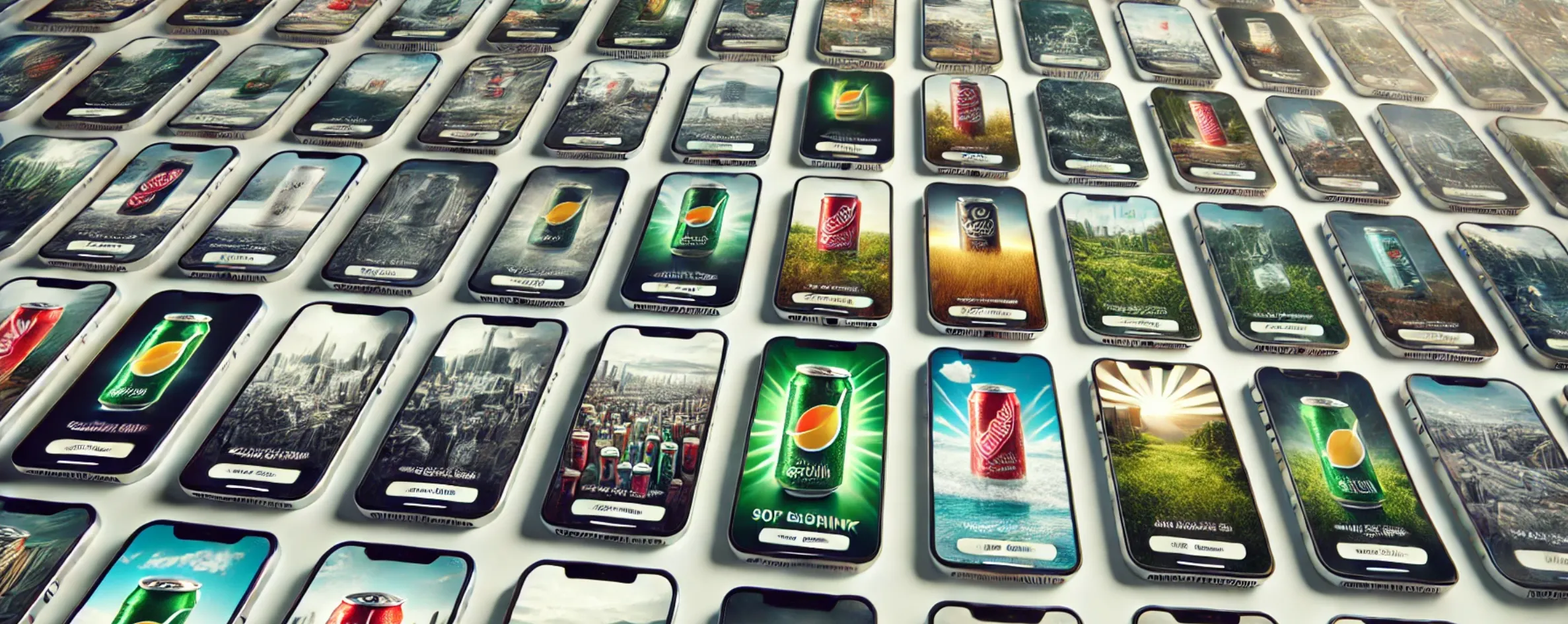
The Meta AI Sandbox shows this already starting to come to life with support for text to image background generation so you can personalise how your product is placed, based on what works best for that customer. When you combine this with their Advantage+ Custom Audiences you can start to see a wider picture emerging that could allow you to use your own customer data to drive highly personalised copy and creative within Social Media ads — at scale.
As these Gen-AI tools become more automated and more accessible across different channels — social, email, in-app content — it will inevitably help to scale personalised messaging, allowing all marketers to use these tools to autonomously create specific, tailored communications.
In fact, we may need a new way to describe this capability.
Within a marketing context we’ve been using Personalisation and more recently Hyper-Personalisation as ways to describe doing highly targeted and highly relevant marketing. However, with AI and Gen-AI, we have the possibility to truly create one-off communications just for that single customer. More akin to a bespoke suit than a mass-customised or mass-produced one.
This new form of marketing leverages Generative AI (Gen-AI) capabilities which enable the production of text, images and other media using generative models. These models can essentially generate new and novel content based on the data they were trained on. Not simply predicting what existing content is the best fit, instead, these models can enable the creation of new content.
It’s in part marketing automation (MA). It’s in part Gen-AI.
I’d argue it’s Gen-MA (Generative Marketing Automation).
With a Gen-MA solution, you could create automated and importantly, autonomous, scalable marketing messages that are in the right language, right tone of voice and with the right content. Messages with personalised video and/or image content just for me. Messages sent based on what I buy and when. Messages for the right product to encourage purchase. Messages with the right promotional value to encourage trial or purchase.
Gen-MA has the potential to supercharge CRM and loyalty marketing across the 3Cs of CRM — Content, Cadence and Compensation — more messages, more relevant, more often.
Or will it?
Newtons third law states, ‘With every action there is an equal and opposite reaction’.
What if we, as consumers — as marketing recipients — also leverage AI to increasingly control what we want to see?
One way in which this can come to life is through the concept of ‘agents’.
These are AI powered solutions which learn and can make decisions on our behalf. OpenAI defines these saying “GPTs will continue to get more useful and smarter, and you’ll eventually be able to let them take on real tasks in the real world. In the field of AI, these systems are often discussed as ‘agents’ ”.
In discussing the emergence of agents, McKinsey said “We are beginning an evolution from knowledge-based, Gen-AI-powered tools — say, chatbots that answer questions and generate content — to gen AI–enabled “agents” that use foundation models to execute complex, multistep workflows across a digital world. In short, the technology is moving from thought to action.”
Whilst McKinsey was specifically discussing Gen-AI Agents within a business context — acting as a co-worker for example, booking travel — it’s easy to imagine that they could also act in a personal context.
Essentially, acting as our own ‘proxy’, an AI agent could be designated as a substitute or stand-in for us; carrying out duties or making decisions as if they were us. In a consumer marketing context, reviewing whats sent to us and deciding what we see.
This isn’t some imaginary future, it’s happening to some degree today.
Apple’s focus on privacy (and it’s walled garden) provides a ‘proxy’ service today that hides your email address from the sender and in the process, gets to handle your email on your behalf. With their iOS18 announcement in June 2024, they are extending the email features to include automatic categorisation of emails and automated summaries. You’ve essentially delegated email receipt, filing and first reading to your Apple proxy.
It doesn’t take much imagination to add an extra layer in here — an AI agent — which further filters based on the content and your preference for it.
Your agent could review your email and indicate if a retailer or supplier you typically frequent has a great offer on a product or service it knows you’ll like — where the consumer-side AI is understanding our preferences and making decisions on what to show and when. Knowing how valuable an offer is; how relevant; how timely.
Based on information we provide of things we want to achieve or do. Based on fact checking marketing messages — whether news, opinion or a retailer’s reputation. Based on our buying behaviour and previous interactions with marketing messages.
Conversely, your AI agent will also make decisions on what not to show and what not to tell you about. Sure, you can dig through the raw emails to find it, just like you would within your spam folder. But we don’t and we won’t.
As the filtering, summarising and prompting by your AI agent gets better, irrelevant emails and communication will stay irrelevant.
This will be consumers using AI within their own tools to automatically filter marketing messages. Based not on the needs of publisher to make money but instead based on the needs of the user.
In this world, marketing messages won’t simply need to cut through. They’ll need to truly add value. Messages with a strong call to action, solving a user need, at a price point that’s relevant and from a supplier that has a strong engagement with the consumer.
As marketers, this means that a consumer may never see our beautifully targeted and crafted communications if ultimately, they didn’t pass the consumers own AI agent — if they weren’t considered relevant.
It also means we may start to see a different way of managing communications, with more machine-to-machine interactions.
If you unpick how email marketing works today, we’re essentially using data and technology on the supplier side to decision a communication and offer to the customer. This then gets communicated to the customer via rich text and images — using a technology which is over 50 years old — in the hope that it’s seen, understood and responded to. A process that is repeated for every brand and every offer.
With the advent of consumer side AI agents, these emails will get less viewing and less engagement. Summarising them and prompting those that matter may simply be a stepping stone to a new approach, one which removes the need to craft these rich emails in the first place. Instead, a better way may be for the consumers side — the AI Agent or Personal Assistant — to deal directly with the supplier side to help negotiate and decision any offers.
Why subscribe to a loyalty marketing email when your agent can simply connect directly to the loyalty programme — machine to machine — and review offers on your behalf; or better still, negotiate offers based on your needs and wants.
In this model, data is not only needed on the supplier side to decide on the consumer offer to make, but also on the consumer side in terms of representing what that consumer may want and may be interested in.
This may sound far-fetched, but it’s one of the reasons yuu Rewards Singapore was setup — to connect and collect consumer data via the loyalty programme, specifically to support AI decisioning.
Micheal Zeller, Head of AI Strategy and Solutions at Temasek elaborates on this saying “we created minden.ai [owner of yuu Rewards], [..] to redefine engagement between brands and consumers [and] subsequently launched the yuu Rewards Club [in Singapore]”
When describing this new way of engaging between brands and consumers, Miden.ai indicate this will be “through the power of machine learning and artificial intelligence”; with Minden.ai’s CEO, Chen Peng going on to describe how this would work saying “generative AI will drive a boom for digital personal assistants. Apps are design[ed] for Human to machine interaction. With the digital assistant’s boom, businesses need to get ready to develop applications designed for machine to machine interactions,”
Whether we reach the point whereby our apps and communication providers are negotiating on our behalf as ‘agents’ or ‘personal assitants’ to secure offers and deals on things we want or might like still isn’t clear — maybe we’ll still need great creative and ads to foster that interest and desire.
What is clear though is that Gen-MA in the form of automated and semi-autonomous creative marketing is already here in some areas and will likely expand quickly into others. Our job as loyalty and CRM marketers will be to ensure we’re collecting the data, capturing customer interactions and setting the right guardrails for its use. We’ll also need to make sure that what is decisioned and created is performing well and delivering value.
In that respect, nothing much changes.
Update: Where This Stands Today (23rd April 2026)
Much of this was written at a time when generative AI was just starting to move beyond experimentation into practical use.
Since then, the picture has become clearer — but not in the way many expected.
AI has scaled rapidly on the producer side of marketing. Creating content, optimising campaigns and improving efficiency is now commonplace. But on the consumer side, the shift is more gradual.
We’re starting to see early signs of this emerging. Tools like Openclaw point toward a future where agents can act on behalf of users, while developments such as Apple's reported update to Siri (codenamed Campo) suggest a more integrated approach, allowing it " to better understand requests, complete tasks inside apps, and search the open web using Apple-built interfaces and models" all while using your own chosen model such as "Alphabet's Gemini or Anthropic's Claude directly" — this potentially positions Apple as an intermediary layer between the user, their chosen models, and a wider partner ecosystem.
These are still early steps. though.
The fully agent-driven world described in this article — where assistants actively negotiate, decide and act on our behalf — is emerging rather than established.
What this reinforces though is that the direction of travel is likely right, but the timeline is longer.
For now, most marketing still needs to work in a human-facing world — but increasingly, it also needs to be structured in a way that machines can understand, interpret and prioritise.
In that respect, the fundamentals remain the same.