

Fuel for Loyalty
Rethinking CRM Design
Mark Sage - 10 min read - 4/02/2025
Aloyalty programme without direct marketing communications is like a car without fuel — It simply won’t move forwards.
Interestingly though, marketing communications tend to be a more undervalued aspect of the loyalty programme design. A lot of time, effort, and investment is put into the loyalty mechanics — the currency, the economics, the rewards and the app — but the loyalty comms themselves can sometimes be relegated to a functional role of welcome emails and birthday mailings.
On yuu Rewards we tried to approach this differently — and we had loyalty communications as a core part of the overall programme design and operations. However, even with a strategic focus on developing a strong loyalty marketing approach, looking back, I feel we missed a massive opportunity to create more value.
It’s worth then stepping back to understand how we thought about loyalty communications and equally, what I’d do differently today.
Back in October 2019 we’d started crafting the marketing journeys. This would be our second attempt at this, as we’d previously hired a well-known direct marketing agency to build it out, but what they delivered was simply uninspiring. It was the standard mix of welcome journey, nurture, redeem and birthday.
Having sat through the presentation, I was left feeling like it was something we could most likely have done as a team, on the whiteboard, in less than an hour. It was creatively well presented, but the strategy itself, lacked any actual strategy.
That’s not to point a finger at the agency though. I think we could have had any agency sit in the room in 2019 and we’d have received the same presentation. Indeed, our second attempt a few months later to map out the journey for loyalty communications was equally lack-lustre.
The challenge here is that everyone follows the same rulebook. Leveraging journey-based communications triggering at key points in the members lifecycle.
Aimia — who back in the day were one of the largest loyalty companies globally — even published a white paper on it entitled “7 Email Campaigns”. This talked about campaigns such as the ‘The Welcome’, ‘The Statement’ and ‘The Win-Back’. Essentially, a suite of campaign communications which map to the members journey within the loyalty programme — something you can summarise as ‘Learn, Earn, Burn, Turn and Churn’, and something we largely followed within yuu Rewards.
So, lets stick with the rulebook for a while, and go through what we developed on yuu Rewards and why. Then I’ll explain what I think we missed.
Broadly, you can divide standard loyalty marketing communications into four areas which are: -
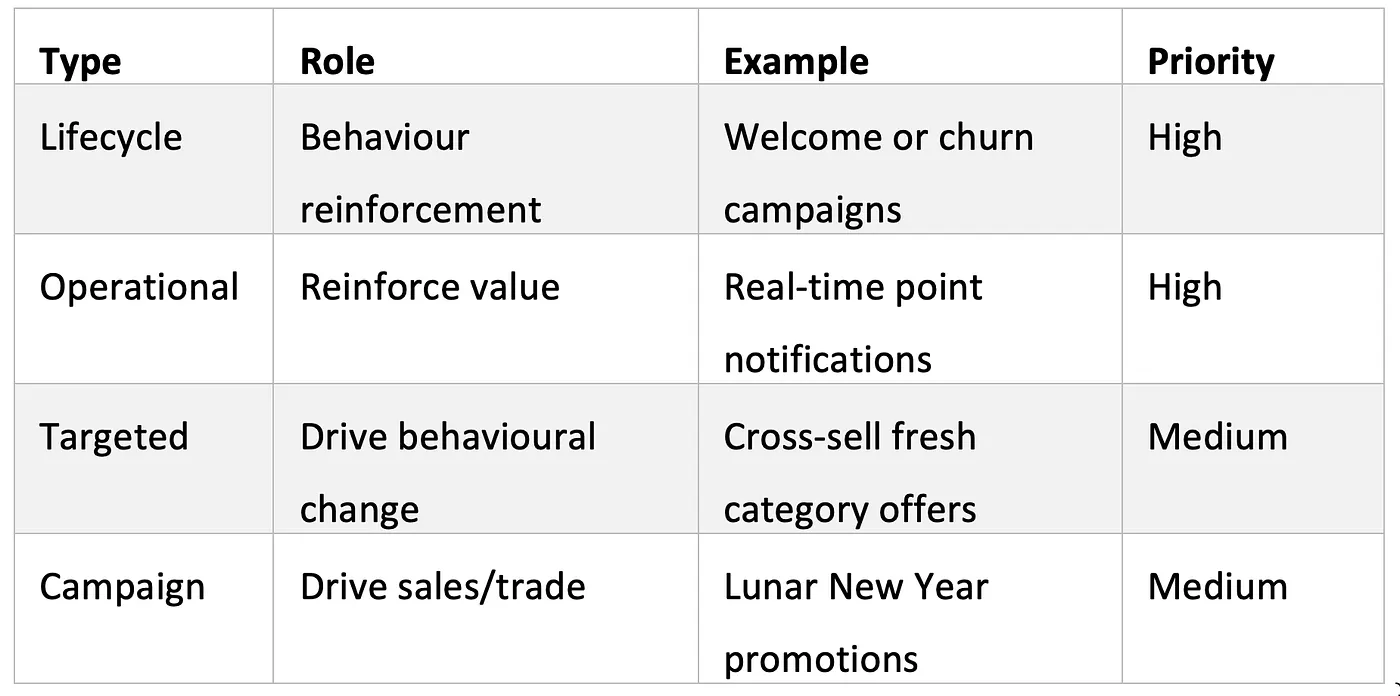
Lifecycle Communications — Typically the foundation of the programme, these are triggered campaigns that (should) run unattended and automatically to help you respond and react to member behaviours — or the lack of.
Operational Communications — Also automated, these generally respond to specific member actions such as points earning, tier achievement or redemption.
Targeted Communications — Focused on defined customer groups, these communications will tend to be used to try and change behaviour, with cross-sell and up-sell being the standardised approach.
Campaign Communications — Used more as trade driving comms, these will typically centre around seasonality, such as Christmas or Lunar New Year, and will largely map to the retailers own in-store campaigns.
These are all great communication types and are all needed. Some loyalty programmes will do more or less of each, but generally most loyalty programmes will have communications operating across these areas.
So, lets break these down a little more.
Lifecycle Comms
These communications are customer behaviour focused and aim to keep customers on the loyalty journey with engagement and encouragement in terms of the next step to take, and positive ‘course correction’ where the customer may misstep.
They start with enrolment, ensuring that new members are onboarded to the programme and understand how to get the best out of it (“Learn”). Normally a mix of education (getting unstuck) and promotional (getting stuck in!), these communications seek to maximise initial engagement. Typically, behaviours at 14 days mirror behaviours at 14 months, so if you want customers to be active, starting early is the easiest way to do it.
Having got people through that ‘nurture’ journey, it’s now a case of wait and see.
If they keep doing something, then the pre-redemption and redemption comms will start (“Burn”). If they stop doing something (or never really started), then the lapsing journeys kick-in (“Churn”), trying with ever increasing levels of repetition to get the member to come back. These work, but only for a very small percentage of members. At some point you have to give up, and then the member is moved into a ‘dormant’ state where you continue to send campaign comms to them (just in case), and every now and then attempt to re-activate them at key moments in the calendar — and on their birthday, if they’re lucky!
I speak about these journeys with an element of sarcasm, but honestly, these campaigns are all necessary and should be part of any foundational loyalty marketing comms. The reason though that I have an air of disdain is not with the communications themselves — they are genuinely useful — it’s with the fact that for many, these journeys are loyalty marketing.
That by doing redemption and lapsed marketing campaigns, sending an email on their birthday and saying ‘Merry Christmas’, the programme is somehow delivering on its objectives to identify and grow customers.
To be clear, for me, this isn’t loyalty marketing. Useful. Necessary. But the job isn’t done.
It also doesn’t address a gaping hole in the strategy, which is that at any time, only around 5% of your market is ‘in the market’.
The Aimia “7 Campaigns” indirectly touched on this gap with the 3rd campaign, “The Statement” — the purpose of which they said was “to make a regular and predictable appearance so that your brand becomes a part of your member’s routine”. Whilst “Statement” is now likely the wrong description for this , and I’d argue the rationale has changed, this campaign is on the money — and at yuu Rewards we missed it.
That, however, is for discussion in a future article; for now, lets continue.
Operational Comms
Typically these are the poor cousin of loyalty marketing. However, whilst they may be operational in nature, it would be wrong to think of them as something with lesser value.
These communications provide reassurance that something has worked and a reinforcement that the programme is delivering value.
Ultimately, these operational communications give you a ‘free pass’ at fostering member engagement because they come on the back of a member’s own behaviour and so are expected, and in most cases desired.
In a sense, the member doesn’t think of operational communications in the context of marketing.
This means that you can, and should, leverage every member action to create a communication-based re-action, driving up the programme touch-points and ensuring you stay relevant and responsive to customers.
On yuu Rewards, we designed in different push notifications for many of these types of communications, with one of the most popular being the real-time earn push message. This was sent instantly based on any partner points earning activity and helped to reinforce the programme with members, letting them know they’d just earned more value, and helping provide habit-forming reassurance.
The other thing about operational comms is that you can typically bypass marketing opt-in’s with these. You need to change the messaging to ensure it is 100% non-marketing, but even when it’s purely operational, it still allows you to connect with a member and reinforce the programme.
The take-away here then for operational comms is to: -
Maximise every opportunity to react to a member’s behaviour and trigger an operational message on it — whether earning, redemption, change of profile or saving an offer. Make sure your loyalty marketing appears responsive and essentially thanks them for their activity.
Leverage for marketing where you have consent — the core message should be around the reason why, but don’t miss out on the opportunity to up-sell the value. For example, within yuu, when shopping at the Wellcome supermarket, we had our real-time push notifications say “You’ve just earned 1000 points! Don’t forget you can also shop online.”
For marketing opt-outs, maximise the use of operational comms to create a level of engagement, but don’t try and be clever and sneak marketing in. Respect the members wishes and permissions (and the law!).
You may have noticed that I’m talking a little more positively here about operational communications than I did about lifecycle communications — there is a reason for this.
The nature of these communications automatically means they connect with active customers, who by definition have just done something with your brand and hence have given it consideration. Typically, customers shop at a brand or purchase a product through a ‘Category Entry Point’ or CEP. Described as “the cues that category buyers use to access their memories when faced with a buying situation”, these Category Entry Points are how someone who decides they have a need (“It’s hot and I’m thirsty”), can then associate it with a memory / brand to meet it (“A Coke is refreshing”).
Ideally, we want to be the brand that comes to mind alongside the need.
From a loyalty marketing perspective, operational comms are on the other side of the Category Entry Point — the customer has essentially purchased and so ‘exited’, but that doesn’t mean this isn’t a valuable moment.
Using operational communications tied to that purchase event, we can celebrate and reinforce it. Essentially, using messages that the customer is more open to receive as it’s linked to their own activity, but which deepen the neural connections associated with the behaviour.
A study entitled “Neural Basis of Reinforcement Learning and Decision Making” highlighted how “Rewards in the distant future are often temporally discounted so that more immediate rewards exert stronger influence on the [..] behaviour”. Essentially, more immediate feedback mechanisms help reinforce decision-making in the near-term by strengthening associations (and neural pathways) between actions (purchase) and rewards (points earned).
So, the fact that someone has just made that purchase means they’ve already built that connection to some degree — that Category Entry Point (CEP) — and our response to it through a timely and relevant communication can help to highlight this, deepen the association, and strengthen the reward linked.
Within Lifecycle lapsing communications, you’re trying to rebuild or re-ignite that CEP. However, with operational comms, it’s right there in front of you. This is why for me, these are some of the most valuable loyalty marketing communications you can put in place — yet many programmes don’t, and that’s a massive, missed opportunity.
Targeted Comms
Now these are the workhorse of loyalty marketing and done well, can really drive additional value. But doing them well is tricky.
Based on customer data, and the underlying behaviours these help to shine a light on, targeted communications can leverage this and start to nudge customers to do more and to try new things.
This can obviously be small, discreet segments of customers — such as members who only come in for a large shop, but don’t consider you for a mid-week top-up. It can also be mass targeting in terms of how you personalise the ask and the offer, such as a targeted spend stretch and reward. Ultimately, targeted communications are about relevance and ensuring that what you say and what you offer are aligned with what the customer does (or doesn’t) do today.
The challenge with targeted comms, is that day one, you typically don’t have any data and so have little to no plans to leverage it (well).
This means the tendency when building the loyalty marketing CRM plan, is to focus on Lifecycle comms in the main and leave targeted for later. It feels easier to think through the customer journey from a loyalty perspective — learn, earn, burn, churn — than to think it through from a business perspective — the “turn” or change of behaviour.
This would be another potential missed opportunity though — and it’s one I feel we also made on yuu Rewards.
Typically, the business knows what the core challenges are, such as getting customers to purchase fresh products within grocery so you can drive up everyday frequency. You can also use existing data such as through market basket analysis to identify potential gaps in customer behaviours.
What it means though is that before launch, you’re building a data and strategic fluency of the business, with an aim to use the connection the loyalty programme will provide to unlock this. Not thinking about customers through a ‘loyalty ladder’ lens — unknown to known to advocate — but thinking of them through a customer behaviour lens — how they buy and what they could buy more of.
We certainly got there on yuu Rewards, developing multiple targeted campaigns that delivered real customer growth, both within and across the partners, but it wasn’t there day one — and it could have been.
Interestingly, those lifecycle communications we spent so much time (and money) designing and delivering, hardly got a mention. We never really went back to look at how they we’re performing outside of the initial start-up offers, and other than the odd brand refresh, we never really focused on them post-launch.
We did though beef up operational communications and also added more instant feedback within the app itself such as celebratory confetti on screen when you redeemed or activated an offer. We also did a lot of targeted communications, targeted offers and personalised rewards.
The takeaway here is not that Lifecycle comms aren’t important — they are — it’s simply that they are not the most important part of loyalty marketing communications and should not be 90% of the discussion.
As the table below shows, each communication type has a different role to play and ultimately, different value to add.
That said, we’ve missed a whole category of loyalty communications.
We’ve missed them here, and we missed them on yuu Rewards. Before we can explore them further though, we’ll need a change in perspective.
I’ll pick up on that in “Why loyalty doesn't work the way you think”.