
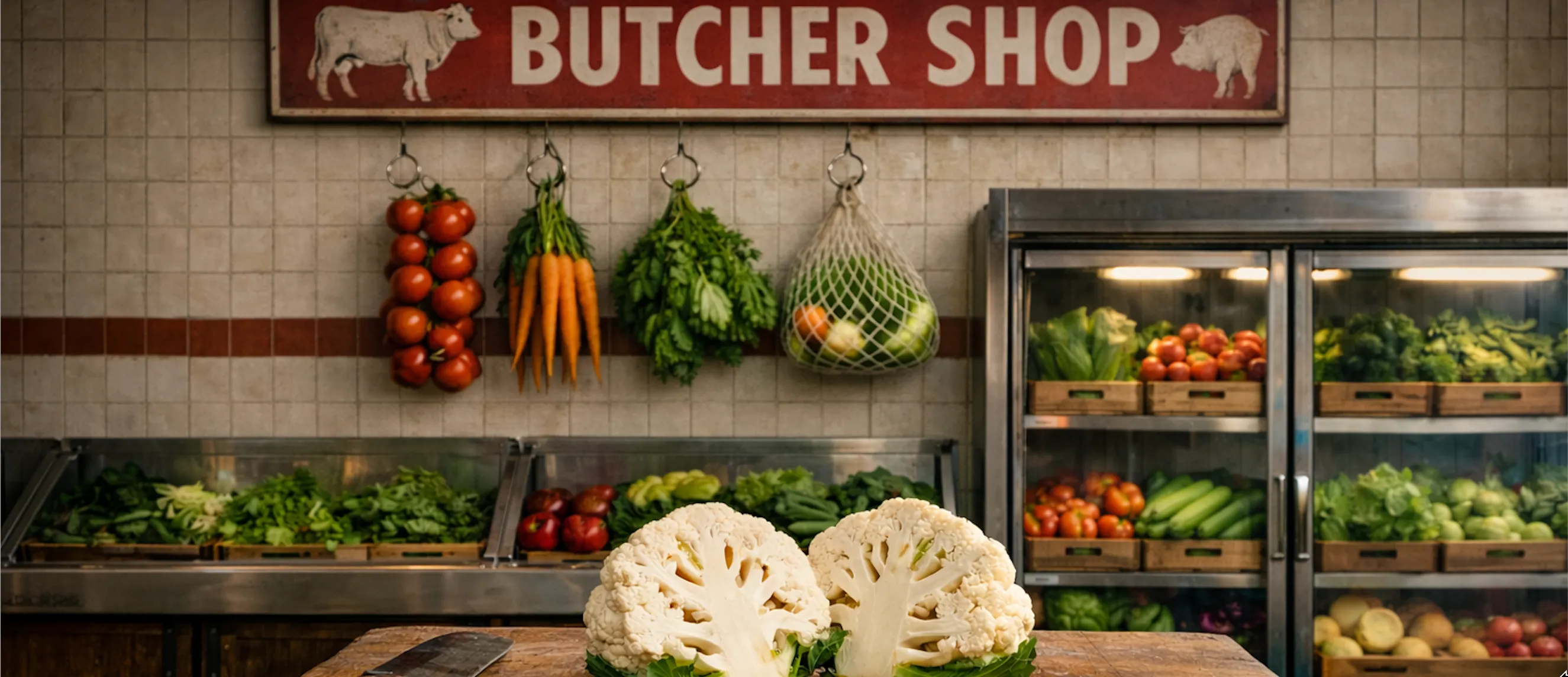
We had no idea you’d turned vegan!
Personalisation to Contextualisation
Mark Sage - 8 min read - 09/02/2026
Marketing has spent the last couple of decades chasing ever more precise personalisation.
It started with segmentation and the idea of one-to-one marketing. From there, personalisation evolved into what is now called “hyper-personalisation” — more data, more models, more rules. But while the tooling changed, the premise largely didn’t. The aim was, and still is, to be relevant to the customer based on what they have previously done; leveraging buying and viewing habits to predict the next best thing that will capture attention and sustain purchase behaviour.
Yet for all that sophistication, something still feels off.
Brands have never known more about their customers, but that understanding often gets reduced to little more than a product offer based on what you bought before, what people like you tend to buy next, and if you’re lucky, what the weather is like outside. The implicit goal seems to be to maximise attention for as long as it lasts and then move on.
When customers change — when heavy buyers drift, needs evolve, or life intervenes — the default response is still to keep pushing offers based on past behaviour, in the hope that customers might return to doing what they did before.
The challenge here isn’t personalisation itself, it’s that personalisation is answering the wrong question.
Hyper-personalisation is exceptionally good at optimising continuity. You bought this, so you might want that. It assumes the future will broadly resemble the past, perhaps with a little stretching at the margins — a higher-margin variant, a slightly larger pack size, a modest upsell. Fundamentally, though, it plays within the customer’s existing frame of behaviour.
Built to refine, repeat, and optimise what has already happened, it works remarkably well for transactional efficiency. But it is also structurally backward-looking, with deviation treated as risk, and drift or churn treated as something to address.
There is little room for the idea that the customer themselves might be changing.
I saw this dynamic when I was working on CokeZone in the UK. Years of consumer research had shown a clear pattern, that as teenagers grew up, became independent, and eventually formed family units, their buying behaviour changed. Early consumption of small, personal units gave way to larger pack formats once people had families of their own. None of this was particularly surprising.
The challenge came in the transition between those stages. As teenagers matured, there was often a drop-off in purchase behaviour as tastes shifted toward water, alcohol, or other beverages. This created a gap in consumption, and the response was to launch a loyalty programme designed to enrol these consumers and incentivise them to remain Coke drinkers.
Unsurprisingly, the programme was not especially successful in stemming the natural evolution of tastes, but it did reveal something more fundamental.
Marketing assumed the goal was to bend the consumer back toward the brand, rather than to adapt the brand to the consumer’s changing reality.
The same logic underpins much of CRM and loyalty today. Enormous effort goes into protecting heavy buyers as they fade, or stretching spend within existing categories. It’s marketing designed for preservation, not progression.
In hindsight, I also saw this limitation very clearly after we launched yuu.
We did what modern loyalty programmes are supposed to do. We built personalised marketing and personalised offers. Segmented customers by buying frequency — loyal, occasional, uncommitted. Segmented by behaviour, trying to understand whether you were a family shopper, someone who enjoyed dining out, or a keen home cook.
We modelled promotional sensitivity down to the cost per weight unit paid, so we knew who shopped on promotion, who bought in bulk, who responded to discounts, and how price elasticity played out across the base.
All of this was grounded in a simple assumption that you are what you buy.
And yet, in all that slicing and dicing, we missed something far more fundamental.
We had no idea you were vegan.
A sustained absence of meat and dairy purchases was never interpreted as a signal about the customer themselves. Instead, it was framed as a category issue — an opportunity to extend range, cross-sell alternatives, or stimulate demand elsewhere. It became a buying and merchandising question, not a customer understanding one.
From a CRM perspective, nothing was obviously wrong. The customer was still shopping, still active, still engaged in places. There was no churn event, no alert, no reason to pause. Yet from a human perspective, something meaningful had changed, and the system had no way of recognising it.
Marketing was centred on the needs of the business — the banners, the categories, the products — but the customer themselves was largely left out.
The question we didn’t ask was simply — what are your needs?
This wasn’t a data problem, or a lack of analytical sophistication. It wasn’t even an AI problem. Instead, it was a framing problem. We were optimising what to sell next, rather than trying to understand who the customer was — and, more importantly, who they were becoming.
It’s worth imagining how things might have played out differently if we had asked a different question. Not a more granular one, and not a more predictive one, but a more human one.
Suppose the system noticed that meat and dairy purchases didn’t just dip for a promotional cycle but disappeared entirely, and that this absence persisted quietly over time. Suppose that absence had been treated not as a gap in category performance, but as context.
Nothing dramatic would have been required. No declaration of veganism, no labels, no assumptions. We might simply have stopped talking about meat altogether. Recipe suggestions and offers could have leaned naturally toward dishes that made sense for where the household was now. Content would have felt aligned rather than coincidentally adjacent. The brand’s voice would have sounded like it understood, without ever needing to say so.
The system wouldn’t have needed to know the customer was vegan, it would only have needed to recognise that their context had changed and behave accordingly.
That isn’t better personalisation. It’s something else entirely.
Customers don’t simply repeat their behaviour. They move through life stages, constraints, priorities, tastes, health changes, family structures, financial pressures, and shifting availability of time and energy.
Relevance doesn’t come from knowing what someone bought last; it comes from inferring where they are heading.
This is where the concept of contextualisation becomes important.
Contextualisation isn’t a more advanced form of personalisation. It’s a step back, and a step up. Where personalisation asks what content or offer should be shown next, contextualisation asks what kind of support, tone, or choice makes sense given a customer’s current situation and trajectory. Personalisation selects content; contextualisation frames relevance. One seeks to optimise transactions, the other seeks to sustain relationships.
This distinction becomes even more important as we move toward conversational commerce. Brands are no longer just pushing messages through channels; they are increasingly expected to answer questions, make suggestions, explain trade-offs, and help customers decide. In this world, brands start to behave less like broadcast systems and more like companions or coaches.
In conversation, personalisation quickly reveals its limits. Systems that are very good at optimising offers can feel awkward or self-absorbed when asked to participate in dialogue.
Hyper-personalisation, designed for feeds and emails, can come across like the annoying friend who keeps turning every topic back to themselves. You ask a simple question — what should I cook tonight? — and the response optimises for what the brand wants to sell rather than what makes sense for you in the moment.
It’s no surprise this is exactly the gap that Anthropic recently highlighted in their latest advertising when pushing back on how they won’t be placing paid ad content in their own AI chat.
You see, conversation isn’t about prediction; it’s about situational awareness.
A good conversational partner doesn’t constantly reference your past behaviour. They pay attention to what you’re asking now, the constraints you’re under, and what is likely to help given your circumstances. That requires context, not just history.
The fact that you’ve been a meat eater for the last twenty years has little relevance to your decision to stop today. No amount of “20% off” or “buy one get one free” is going to change that.
Contextualisation then, is the process of understanding where a customer is today and where they are heading. Not focused on who they were, but on who they are becoming.
Contextualised marketing is about recognising behaviour shifts without naming them, adapting tone without asserting intent, suggesting without prescribing, and supporting without steering. It’s about making interactions feel as though they are for the customer, rather than for the brand.
None of this is to suggest that personalisation no longer has a role.
When customers are stable and behaviour is consistent, adjacent recommendations work perfectly well. Suggesting pasta sauce with pasta isn’t a failure of imagination; it’s simply efficient.
The limitation appears when we mistake that efficiency for understanding.
One of the under-appreciated realities here is that brands often see change before anyone else does. Rich first-party data gives brands an unusually early view of shifting behaviour — subtle changes in what people buy, how often they engage, and what they quietly stop doing long before they say anything explicitly. In theory, this should be a competitive advantage. In practice, it creates a choice.
That data can be used defensively, as an early warning system to resist change. Signals of drift triggering win-back activity and deviations from historical patterns becoming problems to solve. The system notices something slipping and tries to pull the customer back toward who they used to be.
Or the same data can be used interpretively, to understand direction of travel. Instead of asking how to restore past behaviour, the brand asks what this change represents, what constraints or priorities might be driving it, and how relevance should evolve as a result.
Those are very different responses to the same information.
The first treats change as loss.
The second treats change as an opportunity.
Personalisation systems are naturally biased toward the former because they are designed to optimise continuity. Contextualisation opens up a different possibility, allowing brands to recognise that not all change needs correcting, and that relevance often comes, not from resisting movement, but from staying aligned with it.
In a world where customers have increasing freedom to choose platforms, channels, and intermediaries, this distinction matters.
Brands that use their privileged view of the customer to fight change, risk becoming intrusive or tone-deaf. Brands that use it to understand change, have a chance to remain part of the customer’s world as it evolves.
Seen this way, contextualisation isn’t just a smarter way to use data. It’s a stance on what the relationship is for — not to preserve the past at all costs, but to stay part of the conversation as people move forward.
If personalisation is about reacting faster, contextualisation is about reasoning better.
That distinction is shaping the work I’m focused on now — holding change without trying to correct it. I’ll unpack that further in future articles.