
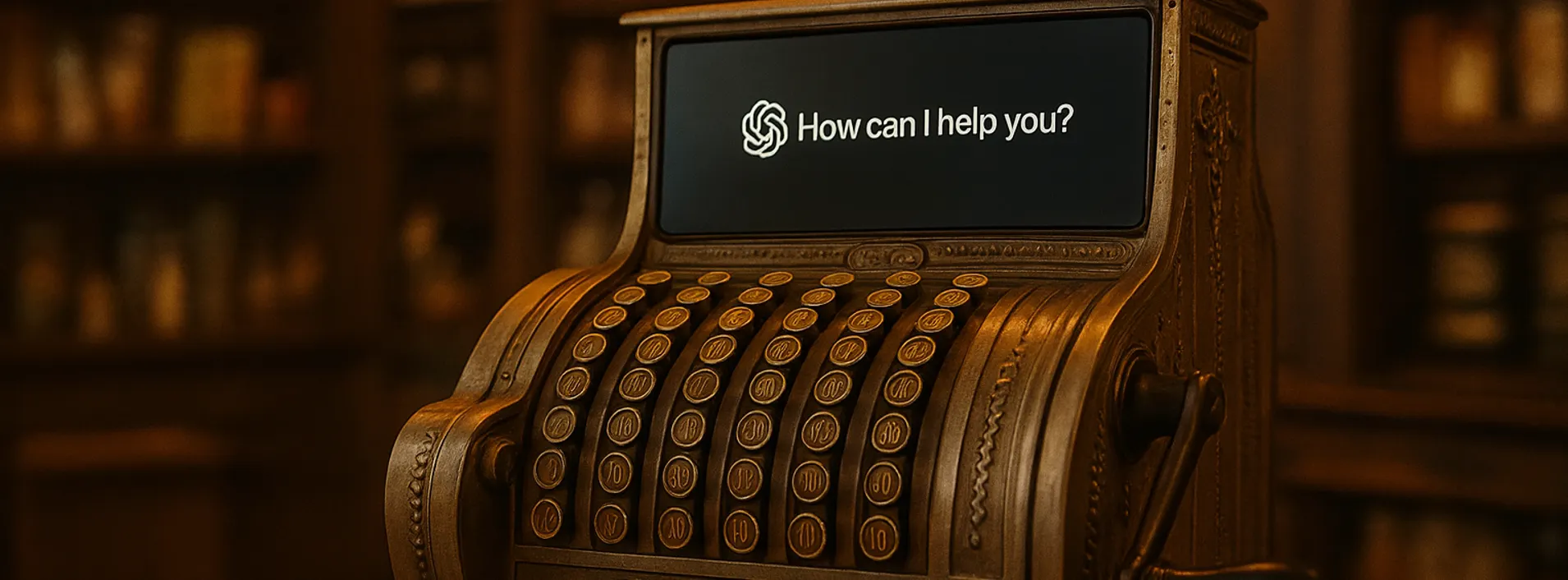
When the Consumption Architecture Changes —
who Survives?
Toys‘R’Us didn’t. yuu Rewards adapted. Amazon is now making its move.
Mark Sage - 9 min read - 04/12/2025
Retail doesn’t change gradually. It snaps. One day the high street is full; the next it’s a memory. One day Amazon is the disruptor; the next it’s defending its own walls. When the consumption architecture shifts, nobody gets to stand still… and this latest shift is just getting started.
The story of disruption though is as old as trade itself. Every few generations, the architecture of consumption shifts — the way we make, sell, and buy reorganises around a new kind of scale. Each time, the wheel turns faster. And each time, someone is left behind.
Once, consumption was a local act. The weaver in her cottage, the greengrocer on the high street, the baker who knew your family.
Buying was personal, grounded in relationships and proximity. What you consumed was shaped by who you knew, and what the community around you could produce.
Then came industrialisation, and with it, scale.
As production moved from cottages to factories, trade moved from local to centralised. The general store arrived, then the department store, and finally the big national chains. Consumption became organised, rationalised, and predictable; and with it trust shifted from the shopkeeper to the shop brand.
For much of the twentieth century that system held. Marks & Spencer, Sainsbury’s, Woolworths — their names became shorthand for reliability. The high street homogenised, but it worked, and scale won, helped in no small part by marketing and branding.
Then the internet arrived, and everything scattered again.
The chain-led high street that had displaced the independents began to fragment under the weight of eCommerce. Geography stopped mattering, shelves became infinite, and checkout was a 24/7 click. Convenience had replaced proximity as the organising principle of modern trade.
For some, this was an opportunity and a chance to reach new customers and compete on equal terms. For others, it was extinction. The butcher and baker had once lost to the big store; now that big store was losing to the small screen.
For me, this isn’t a history lesson. It’s a life lived.
I grew up in the UK at a time when the high-street was a short walk-away. When you still bought your next meal from the greengrocer, and the butcher next door. When your milk came fresh every day on an electric vehicle. Then the supermarket took over. Then the PC allowed groceries to get delivered. Then the mobile allowed whole meals to get delivered in less than 30 mins.
Nothing stands still, and the pattern of disruption simply repeats.
Every time we find a new way to aggregate and communicate with larger groups of people, the structure of the consumption reshapes around it. Essentially the Consumption Architecture changes.
What began with the industrial revolution — the first great scaling of production and distribution — has simply accelerated.
Of course, when the consumption architecture changes, not everyone can navigate the change and make it across. Whether the weaver in her cottage, the greengrocer on the high street, or even the global brand in the mall.
A perfect case in point is the story of Toys“R”Us — at its height, a $12 billion global brand, selling 18,000 different toys across almost 1,500 locations, and controlling 25% of the world’s toy market.
How it navigated — or failed to navigate — the shift from physical store to digital is not just the story of dot-com disruption; it’s an enduring lesson for every wave of change that follows.
You could say Toys“R”Us first succeeded by riding an earlier wave of change — the supersizing era that defined the 1950s and ’60s. An era when, in the US, retail moved out of town and families followed. Rising wealth, cheap fuel, and the freedom of the car created a new kind of shopper, one who would drive for choice. The consumption architecture shifted to bigger stores, bigger ranges and bigger baskets.
But in riding that wave, they missed the next one.
The dot-com era flipped the model from large stores to dark stores.
What once required aisles now required algorithms, and the competitive advantage shifted from owning square footage to owning customer data.
It’s not quite right to say they ignored the internet, but better to suggest they misunderstood the implications of it. In 2000, Toys“R”Us made what looked like a smart move and signed an exclusive deal with Amazon to run its online store, effectively outsourcing eCommerce to the fastest-growing digital retailer on Earth.
At the time, Toys“R”Us CEO, John Eyler said the deal took “about eight weeks” to put together; it took only a little longer for it to fall apart.
Within four years, Toys”R”Us was suing Amazon for breaking their exclusivity agreement by allowing other vendors to sell toys on the site. They eventually won in 2006, with Amazon paying out $51 million — far less than the $200m Toys”R”Us had been seeking.
The real loss though was much deeper.
Amazon had learned everything about Toys“R”Us’ customers — what they searched, what they bought, what they clicked on — and those habits stayed with Amazon long after the court case ended.
What the toy giant hadn’t realised was that it was handing over far more than logistics and website management. It was giving away its customer relationship and it’s understanding.
I remember that time well as I worked on loyalty with Toys“R”Us in the UK, and the programme we ran really wasn’t about understanding customers. Instead, it seemed to me, more about squeezing value out of them.
On the surface it was a tiered programme that unlocked higher rewards the more you spent. These rewards though were largely manufacturer-funded coupons, so no real actual value given back to customers for their loyalty. On the side, every new customer that signed up was quietly sold to data brokers — obviously this was a time before GDPR.
As a business, it seems Toys”R”Us never really grasped the value of customer data. They won through scale and presence — the biggest brand and biggest stores on the high-street. When the music stopped though, and customer habits changed, they couldn’t pivot fast enough.
The more nimble, digital first and data driven upstart — Amazon — simply hoovered up the market demand.
Fast-forward twenty five years and the same story may be playing out again, only this time the new entrant isn’t Amazon. It’s AI.
Retailers such as Coles and Walmart are racing to partner with OpenAI and others, eager to add conversational search, smarter recommendations, and agentic interfaces.
As Coles announced:
“Together with OpenAI, Coles is also exploring how emerging AI capabilities could reshape the shopping experience, helping customers plan, shop and checkout in more personalised, convenient and connected ways.”
I’m sure Toys”R”Us once said something similar about how new technology would “reshape the shopping experience.”
But when that emerging experience becomes the experience, you need to be clear which side of the lens you’re standing on.
When your customers no longer come to your website or store; when the decision on what to buy and how to buy is being made by the AI — what stops this being the next Toys“R”Us moment?
Investor and author Jason Calacanis recently put it bluntly, saying
“If I was a developer of any kind, I would never work with OpenAI… this is a warning… they [OpenAI] are studying you… they want every bit of revenue from the eco-system”.
In this new world, the question isn’t who owns the transaction; it’s who owns the understanding. It’s no longer simply about commerce, it’s about conversation.
When the web first arrived, people went online to reduce friction — to avoid walking from store to store, even if those stores were just around the corner.
Online still has friction though — I have to remember the name or URL, search for a seller, trust they will deliver. Amazon’s success came from removing those points of friction. A massive range, a trusted brand and strong mental availability.
Now though, the friction isn’t just physical, or even digital. It’s cognitive.
Increasingly my life — my intent, my curiosity, my decisions — live inside a chat thread. When I need something, I don’t go shopping; I simply ask. Leaving that thread to visit a website, scroll a product page, and check out a basket will start to feel jarring — the modern equivalent of walking back across the car park.
And when the chat thread is owned by someone else, like AI entrant Perplexity, the once great disruptor now finds itself being disrupted.
It’s not that Amazon doesn’t see what’s coming. They’re working hard to stay on the right side of the lens. However, they’re now the one initiating court proceedings — suing Perplexity for doing exactly what it once did to Toys“R”Us, by disintermediating the customer and acting as the middleman.
Amazon argues that AI browsers like Perplexity’s Comet are “not allowed to go where they have been expressly told they cannot”, with their lawyers saying “Perplexity’s misconduct must end”.
The irony is almost perfect. The middleman that once disintermediated the mall has become the mall, now fighting to protect its own perimeter.
At the same time, they’re introducing features like Buy for Me which allow their own customers to do exactly what Perplexity does, only to other retailers.
The consumption architecture is changing and the battle isn’t over howcustomers buy — conversational commerce is coming in fast — it’s over whoowns that conversation.
History keeps repeating itself. Only this time, the middleman isn’t human.
Amazon still sees itself as the destination, but it knows that the current destination is dissolving. In the age of agentic AI, the point of sale isn’t a page; it’s a prompt.
Just as Toys“R”Us learned the hard way, the danger lies in thinking you’re gaining another seat at the table, when the table itself is being cleared.
Disrupt or be disrupted
The consumption architecture is always changing. Sometimes the shift is seismic, as we saw with the dotcom boom and now with AI, but even in 2021, after we’d launched yuu Rewards, there was a similar challenge.
Agentic AI wasn’t yet on the horizon, but the market was moving fast, and we had to decide where we’d fit.
HKTVMall had become the “Amazon of Hong Kong,” expanding from general merchandise into fresh. Meanwhile, food delivery companies like Deliveroo and FoodPanda were expanding from take-away food into quick commerce groceries.
The platform era was already here — and for us, it posed the same question that Toys“R”Us once faced with Amazon:
Do you leverage the platforms and sell through them, knowing they’ll learn your customers faster than you ever can?
Or do you build your own platform and meet them head-on?
That was our Toys“R”Us moment.
Our answer was a SuperApp — a new ecosystem that blended Wellcome grocery, Mannings health & beauty, and our other retail partners into a single digital experience.

It would bring together quick commerce, eCommerce, and hot-food delivery. Add travel insurance, life insurance, and more, and it became a one-stop shop for life’s everyday essentials.
But the SuperApp was never just a technology project. It was a strategic stance — a decision about ownership.
If the consumption architecture was shifting again, then the real question wasn’t whether customers would buy online or offline, fast or slow, shop or scroll. It was who they would buy through. Whether we would surrender that relationship to the platforms, as Toys“R”Us once did, or build a platform of our own that preserved our right to understand, serve, and grow with our customers.
This is the same question now faced by retailers with Agentic AI — and the decisions you take today could ultimately determine whether your customer stays yours tomorrow.
For us, the SuperApp was our way of stepping forward rather than being stepped around, and it was how we chose to stay in the conversation rather than becoming another retailer aggregated behind someone else’s search bar — or someone else’s prompt.
Looking back, it marked a transformation from loyalty programme to customer platform. From rewarding customers after purchase to orchestrating their entire experience. More importantly though, I think it showed the bravery to step into that changing consumption architecture as a player, not a consumer.
It was about learning how a traditionally offline retailer could both navigate a rapidly changing market and a rapidly changing consumer.
This is where the story of the yuu SuperApp begins.
The build, the vision, the compromises, and the lessons we can take forward as we now face the next evolution in consumption architecture.
The chapters that follow will tell that story (but below is a sneak peak of what we launched).