

Coalition Loyalty - Better With Friends
Mark Sage - 14 min read - 19/07/2024
Coalition Loyalty
For most people, that phrase is likely to be meaningless. A loyalty programme is just a loyalty programme surely. Even within the loyalty industry, talk of ‘coalition loyalty’ can trigger confusion, derision, and forecasts of its impending death.
Given the confusion around the definition of coalition programme, let's dispel some myths and explain what exactly it is, how it works and why it has a strong future ahead of it.
Coalition loyalty is essentially an overarching loyalty programme that works for many different unrelated partners. In a sense, it’s multiple loyalty programmes in one, sharing a single points currency and single brand, but operating for the benefit of each participating partner.
From Airmiles and Nectar in the UK, Aeroplan in Canada, to Flybuys in Australia, the coalition model is generally quite similar. The idea is to bring together the top brands in a market and give them exclusivity in each category — whether grocery, fuel or payments — such that it creates an ‘everyday spend’ network that has a shared recognition currency in the form of points.
This network seeks to encourage participating consumers (‘members’) to consolidate their spend within the partners to the benefit of both the member, through increased and accelerated points earning, and for the partner, in the form of increased loyalty.
In practice, what it’s creating is a ‘walled garden’ that looks to maximise opportunities for members and partners within a closed loop loyalty marketing eco-system.
Depending on the brand, the coalition model brings several key benefits.
Connecting high frequency with low frequency — many brand categories such as speciality retail or F&B naturally have lower customer frequency and this in turn can make it harder for a standalone loyalty programme to make meaningful sense for the majority of their customers. Instead, any loyalty efforts tend to only attract and appeal to a heavy buyer of the brand, limiting the overall reach.
Within a coalition programme, you can bridge this frequency gap through the coalition brand and other everyday partners like grocery. It was ultimately this approach that allowed yuu Rewards to quickly exceed the active-to-brand members of all the partners previous proprietary (standalone) programmes.
Span utilitarian with rewarding — brand categories like telco, insurance, or payments are inherently un-engaging. Once you’ve picked a vendor and have that relationship in place, you don’t really care who the logo is, it’s simply a functioning service. This is a big issue for these brands as that type of brand apathy can put them at risk at times of change and mean they miss out on additional product sales.
Being part of a coalition programme can help functional brands get more everyday visibility and be linked to a much more dynamic currency.
For yuu Rewards, we ensured that these partners, whether payments or insurance, provided accelerated earning within everyday spend and it helped propel the yuu Rewards credit card to one of the largest in market.
Within Nectar, Vodafone was a founding partner with 30% churn at launch and clearly looking for a way to keep customers a little longer. Just 12 months later, Vodafone reported churn had dropped by 2.1% (to 29.3%) which at their ARPU of £297 would have been around £28m in retained income.
Make the mundane, meaningful — There is a reason Starbucks focused on the concept of a ‘third place’ — they recognized that a coffee can become an experience, something they describe as ‘the feeling of warmth, connection, [and] a sense of belonging’.
That’s not bad for a $5 cup of coffee.
The ‘feeling of warmth [and] connection’ is not however how you’d ever describe the weekly grocery shop with kids in tow; that is anything but ‘a sense of belonging’. Yet, with coalition loyalty, one can unlock the other.
That weekly grocery shop or that 4th fill up of the car can unlock a free coffee or a cinema ticket that then goes on to unlock a whole different consumer experience. This is how coalition partners can complement each other and bring mutual value and it’s how, within yuu Rewards, we had enough redemptions of KFC egg tarts to treat everyone in Hong Kong!
First party prospecting — I know I said in an earlier article that acquisition is not something loyalty can really impact; however, this is not strictly true within a coalition loyalty programme.
Instead, for participating brands in the coalition, the loyalty programme becomes an ‘acquisition flywheel’ because of the overlapping customer segments, with one partner’s customer becoming another partner’s prospect. It still takes work to make it work, but leveraging that ‘walled garden’ gives participating brands their own massive ‘first party data’ media channel to help tip the game in their favour.
This acquisition is though a double edged sword. It’s desired by partners entering the coalition, but equally when they feel they’ve had their fill, it’s also why they leave. The coalition needs to ensure it’s more than just short-term reach for partners.
It’s also worth acknowledging that within a coalition, one brands heavy buyers may remain light buyers of the other partners. The aim here is not to make all coalition members heavy buyers to all partners, but simply to ‘tip the balance’ in your favour to gain slightly higher market share and slightly higher frequency (loyalty) through increased mental availability (awareness).
When Airmiles issuance moved from Sainsburys to Tesco’s in 2002, Tim Mason, then Marketing Director of Tesco, reportedly said that it was ‘like switching on a tap’ — with 60,000 new customers and 35,000 ‘reawakened’ customers joining Tesco Clubcard. However, with 6m Airmiles members at that time, this still represented just 1.6% of their base.
On the other hand, Sainsburys joining Nectar as a founding partner, opened up an opportunity to tap into Vodafone’s customer base which was 13.4m at that point.
Creates Added Value — When the Flybuys New Zealand coalition recently announced its closure after 28 years, CEO Lizzy Ryley said “The landscape for loyalty programmes has changed [..], with businesses now having greater access to technology and capabilities that enable them to create their own highly tailored proprietary loyalty programmes.”
The underlying suggestion here is that one reason for a coalition programme to exist was the technical and operational complexity of running your own programme — sharing these costs made sense.
That was also an argument we used at Nectar when talking to potential partners — the cost of entry for coalition was lower than that of your own programme. This may have been somewhat true 20 years ago, but as someone who sold and implemented a lot of proprietary loyalty programmes back then too, I’d say the math was sketchy at best.
Instead, coalition is not so much about cost saving but more about value add. Modern coalitions are essentially a digital eco-system like Facebook or WeChat — whereas the ‘currency’ for social networks is ‘content’, for a coalition it’s offers.
A strong coalition creates a branded, owned, digital eco-system which can be cost-effectively leveraged by its partners to create deep and engaging reach. The mix of partners provides frequency, surprise, ‘warmth and connection’. It is not a supermarket flyer and it’s not a ‘voucher cloud’.
Done well, a modern coalition programme is a ‘digital third place’ between social and eCommerce- somewhere to browse and be inspired.
This is something I’ll discuss in a future article as it represents the evolution of coalition loyalty — something I’d argue yuu Rewards created, and it’s why I’d suggest it’s a little too early to write off the concept of coalition marketing based on designs from 30 years ago.
Back in the early days of social media, there were many new entrants such as MySpace and Facebook competing for attention. One of the reasons though why Facebook worked and MySpace didn’t was because they structured the content into an overarching branded eco-system. Consumers and brands alike could have a presence, but this was tightly controlled and coherently branded such that it formed a single digital eco-system — an ecosystem that was easy to navigate and easy to use.
Discussing why Facebook was doing better than MySpace in 2009, The Guardian newspaper said “Facebook knows how to offer an unobtrusive tool and then get out of the way. MySpace, by emphasising the features of the site itself, [where] users can customise pages with music, images, colours and fonts[..], misses this point entirely”
In a similar way, coalitions work in-part, because of that overarching ‘super brand’ that sits above and connects across the participating partners. Making it easy to bring different categories and brands (who all have their own colours, tone of voice and images) together into a digital eco-system that (should) be easy to navigate and easy to use.
This coalition brand and its associated CX — whether yuu Rewards in Hong Kong and Singapore, or Nectar in the UK, exists to create a brand connection and brand salience directly with the members and to bridge the partner brands to unlock additional value. This is the secret sauce for coalition.
Whereas a proprietary loyalty programme — one solely owned by a brand — can and generally should sit within the brand positioning of the over-arching brand owner, for coalition it very specifically needs to have its own brand. One which can sit alongside the participating brands and one which can hold its own in the consumer’s mind.
When launching yuu Rewards we talked of ‘painting the town blue’. This wasn’t simply a euphemism, we genuinely wanted to ensure that every person in Hong Kong had awareness of the brand and what it stood for.

yuu Rewards launch advertising — Causeway Bay (2020)
It was a similar story for Nectar in the UK when it launched 20 years earlier.
Duncan Stirling, one of the co-founders of Nectar described its launch saying“The whole of the country went purple. [Department store] Debenhams emptied all their shop windows of products and just promoted Nectar in it. The launch budget was over £30 million spent over six weeks. The awareness level was sustained, and it’s pretty much been around ever since.”
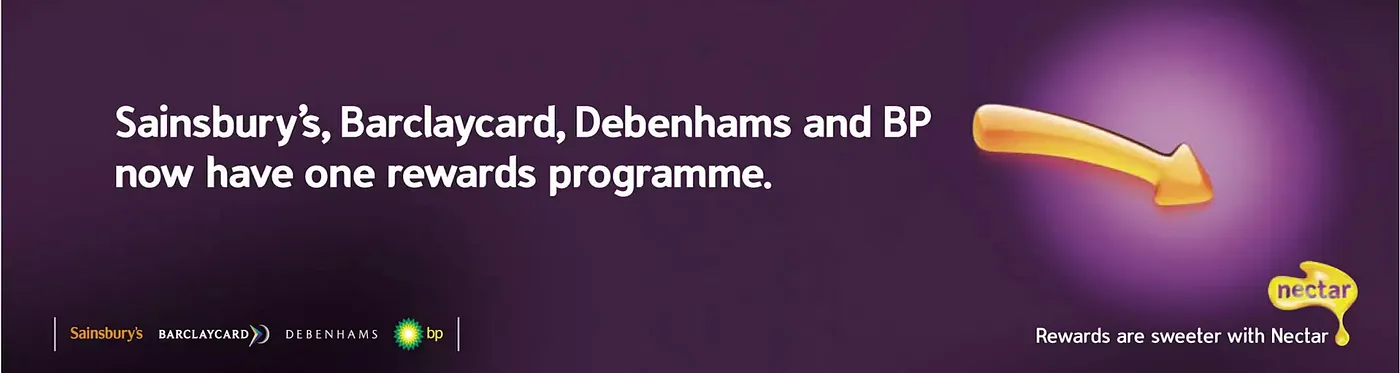
That Nectar marketing budget would be £54m now in today’s money and so suggests an investment of over £2 per household at that time. Whilst two decades later, marketing channels have changed with the addition of digital, social and mobile, we spent a similar value per household launching yuu Rewards in Hong Kong.
So, a coalition needs serious brand marketing investment to hit the market fast and hard and build itself quickly as an everyday consumer brand.
It’s not simply how you launch the brand though, it’s also how you use that brand moving forwards.
If you get the coalition brand positioning wrong, the coalition programme can either end up looking like it belongs to a single partner — to the detriment of the other participating partners; or worse still, it can have no presence at all, driving little brand awareness and loyalty, resulting in fragmentation of the offer and low levels of participation.
Ultimately, a weak coalition loyalty brand means that the big partners either won’t participate at all or will consider themselves the stronger partner and look to control the programme to their own ends. Neither option is good for any of the parties involved — including the members.
Within Nectar, Sainsburys was one of the largest partners who were contributing a significant majority of both the points earn and burn and so tended to have an outsized share of the marketing messages. Whilst this worked well for them, it meant that for many customers, Nectar was perceived as a Sainsburys loyalty programme, not a coalition programme — something that ultimately became a reality when Sainsburys purchased Nectar from the operating company Aimia back in 2018 for £60m. It’s also likely the reason why their last big partner, eBay, walked away in 2024.
It’s worth noting here that post-launch, Nectar was first sold for £360m in 2007. It could be argued that moving from a strong, multi-partner coalition to one dominated by a single partner resulted in £300m being wiped off the value within just 10 years.
Coalition programmes come in different shapes and sizes and there’s sometimes disagreement about what is and isn’t a coalition.
Take Aeroplan for example. A Canadian coalition programme that was originally setup by Air Canada in 1984 and almost 20 years later, was then spun out and sold to Aimia in 2002. It was definitely considered a coalition programme when I worked at Aimia, and it had the hallmarks of a coalition programme. There was a separate brand, multiple partners and a shared currency. In 2018, Air Canada re-acquired the Aeroplan programme for CA$450m along with banking partners TD, CIBC and VISA.
So, is Aeroplan still a coalition programme or is it a proprietary programme with partners?
Qantas is another example. They have a strong frequent flyer programme, but also many partners including not only the usual credit card partners, but also grocery — with a partnership with Woolworths, one of the largest grocers in Australia. You can earn points at BP when filling up your car by just scanning your Qantas card. You can earn points in-store buying shoes at SubType, Earn points streaming TV on BINGE or dining out at restaurants. You can even earn points on your utilities bill spend through Red Energy.
Is Qantas Frequent Flyer a coalition?
Lets get back to basics here. Whether intentional or not, all coalition programmes tend to have an anchor brand and it’s typically an airline or a grocer.
For the airline, this acts as a ‘reward led’ coalition whereby the partners in the programme provide earning opportunities to allow the member to achieve that dream trip. For a grocer, this acts as an ‘earn led’ coalition whereby the member is turning everyday spend into little treats — such as cinema tickets, meals out or the big Christmas shop.
In both cases, the anchor brand tends to be the leading partner and the main draw. Whether Sainsburys in Nectar, Coles in Flybuys, Air Canada in Aeroplan or Wellcome in yuu Rewards — the pattern is similar.
This means that a programme like Qantas with a main leading partner such as the airline, doesn’t preclude it from being considered a coalition.
Ownership structure could be another way to determine if a programme is a coalition or not. Where it’s owned and controlled by the parent company, you could argue it doesn’t exist for the benefit of all parties. However, simply being owned by the one or more of the participating companies doesn’t stop it from being a coalition.
Coalitions can be proprietary. That is to say that many of the big partners are owned in whole or in part by the parent company; this is the case with yuu Rewards in Hong Kong. It doesn’t stop non-owned partners like Hang Seng Bank and Shell participating, but it makes building the coalition a little easier (sometimes).
Coalitions can be independent. This was the case with Nectar before Sainsburys acquired it; with Nectar owning and running the coalition but with no customer facing retail assets of its own.
Coalitions can be co-owned. This is the case with yuu Singapore whereby the programme is a joint venture between DFI and Temasek. Same yuu programme. Same type of coalition. Different ownership structure.
So, ownership structure doesn’t dictate whether a programme is coalition or not.
I think the ultimate test of whether a programme is a coalition or not comes down to how it engages and works for its partners.
If the partners exist simply to create ancillary revenue for the programme owner — to extend their network earning opportunities for themselves and their members, then this is more likely a proprietary loyalty programme with a strong partner strategy.
However, if the programme works hard to leverage the currency, customer data and digital eco-system for the benefit of all partners — to act as a rising tide to lift all boats — then that’s a coalition.
This was how Nectar operated and it’s how yuu Rewards is operated; and it means we can now frame the definition of coalition loyalty as:-
A coalition programme is a multi-partner loyalty programme with a shared brand, shared currency, and a shared ambition to leverage all aspects of the programme for the benefit of all partners.
This definition very likely means that the Qantas Frequent Flyer programme is not a coalition programme as from the outside, it appears to be run for the benefit of Qantas and not for the benefit of its partners like Woolworths or BP. Aeroplan (at the time Aimia owned it), certainly was.
Whilst a coalition loyalty programme must develop its own brand positioning and brand awareness within the market, it still needs to operate like a proprietary programme for each of the participating brands.
Each partner not only needs to buy into the “shared ambition to leverage all aspects of the programme for [their] benefit”, but they also need to feel that’s happening too.
This creates an interesting dynamic that is unique to coalition programme design and something I hadn’t really come across in the earlier part of my career which was centred solely on proprietary — single brand — loyalty programmes.
Within coalition loyalty, you have 3 main aims: -
1. Build a strong coalition loyalty brand that has strong loyalty to it. This means being focused on acquiring customers to the programme itself and keeping them loyal.
2. Build a strong loyalty programme for each participating partner. This means being focused on their customers and their customers behaviours to create loyalty mechanics that keep them coming back.
3. Build a strong cross-partner acquisition engine. This means being focused on loyalty mechanics and marketing that seek to get members loyal to one partner to start collecting (and shopping) with other partners in the programme.
There is a tension here between point 1 and point 2 with regard to the resource allocation and share of voice between driving the coalition programme itself versus driving the programme for a given partner. One of the main sources of ongoing marketing reach is from the partners themselves and so continued and elevated owned/on-site media exposure for the coalition is needed.
However, you’re obviously competing for valuable media space within the partner themselves and so ensuring a positive commitment to exposure and reach is critical.
There is also a tension with partners between point 2 and point 3 whereby you’re trying to run a successful loyalty programme for the partner versus trying to recruit their customers (and their spend) to another partner through cross-sponsor acquisition.
I remember with Nectar in the UK, that the majority of the messaging felt like it was coming from the grocery partner Sainsburys. This is to be expected in some ways as they have by far the highest frequency and widest range. For the other partners though, this meant that their marketing cadence, content and compensation was just a little lacklustre — potentially reducing the impact of the programme for them and likely contributing to the exit of many of the founding partners.
Ultimately you end up trying to balance larger partners with smaller, higher frequency with lower, and partners who want to take out more (new customers and redemption) versus those putting in more (existing customers and earning).
I’ll discuss these topics in a later article and how we specifically looked to manage visibility and access in an equitable way, but the take-away here is that coalition programme management is to a large extent client management.
This means that the coalition loyalty team tends to resemble a marketing agency with an account management function that has separate account management resources for each participating brand — including ideally, the coalition programme itself!
A team that is working together to get the best for all, but also a team fighting hard for their individual partner brand’s interests.
All this certainly makes for a dynamic environment!
From the outside, coalition loyalty can look like something that’s had its day. Schemes are closing or being brought in-house and brands are keener than ever to ‘own’ their customer and monetise their behaviours.
The reality though is that coalition loyalty is changing and evolving. New programmes are launching and, like yuu Rewards, they tend to be built around a digital eco-system which provides richer opportunities to expand into retail media, eCommerce and ‘super app’ territory.
Whether brands participate though will always come down to the value exchange. It’s not the programme construct that is challenged, it’s the commercial construct.
To be successful, any coalition needs a myopic focus on how to leverage all aspects of the programme for the benefit of all partners — this includes income, data democratisation and marketing reach.