
Catering To The Customer 'Need' vs 'Ask'
Mark Sage - 10 min read - 6/09/2024
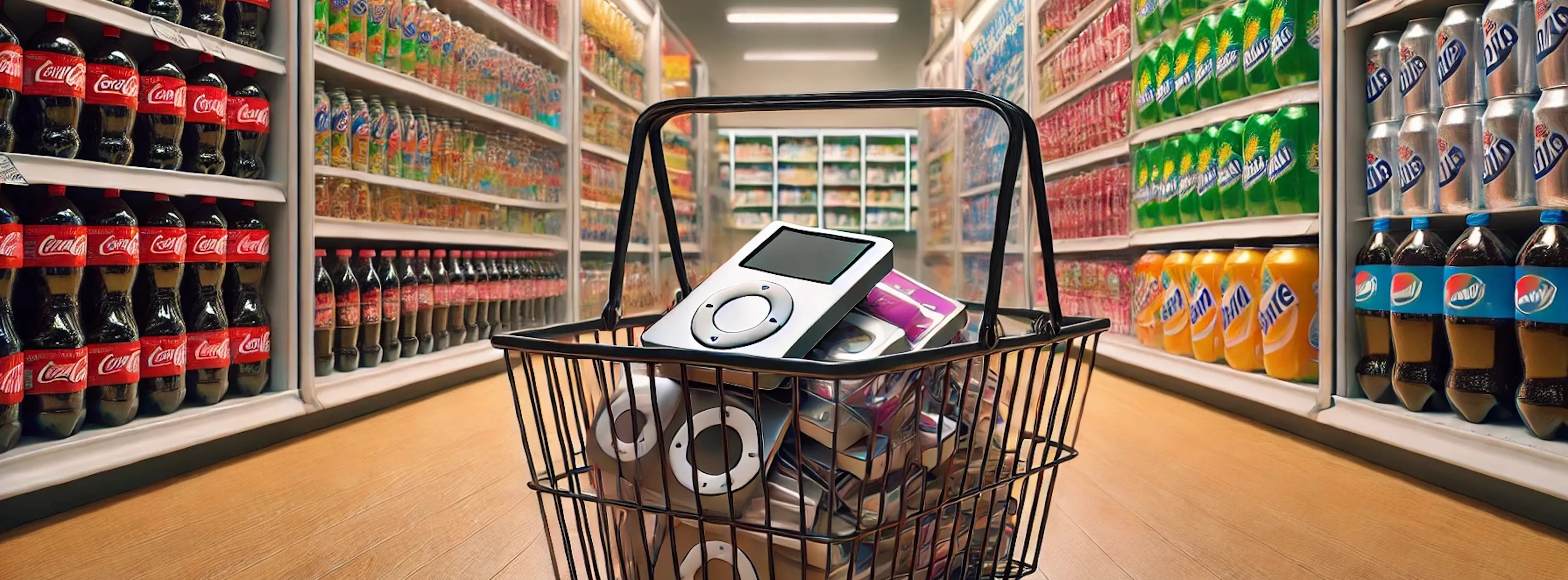
Back to 2008, the iPod Shuffle was a must have gadget and was already on its 2nd generation. Retailing for around $49 USD, the iPod was at the peak of its game, seeing sales of 10.6m units in the first 3 months of that year alone and maintaining Apple’s massive 73% market share. Although growth had slowed for the iPod, with sales only up 1% versus the same quarter in the previous year, music sales were up 35% — to $881 million — and the cache of the iconic white headphones was riding high. It would be almost a decade later before these wired ‘icons of cool’ were replaced by the AirPods.
I reminisce about this, a simpler time, when music was something you owned, even if digitally, because the iPod was also one of the most desired loyalty rewards.
What’s better than a $49 iPod with cool white headphones? A free one!
It was also at this time that I was working on the design and launch of Coke Zone, the CPG loyalty programme from Coca-Cola.
As part of this launch, we carried out customer research to better understand what our target market would want from a loyalty programme — what would motivate them to take part and what kinds of rewards.
Not surprisingly, the iPod Shuffle came out as one of the most desired rewards from customers. It was a perfect fit for the audience — UK teens — and would have worked well with the ‘zones’ we were designing around Sport, Music, Gaming and Fashion.
What the research audience didn’t consider though is the economics of an CPG reward programme — there certainly wasn’t enough money in the ecosystem for the average customer to redeem for an iPod Shuffle; not without some serious cola consumption!
It’s quite common within loyalty programme design to ask customers directly what they want and what would motivate them.
Typically, a research agency would be selected and off they’d go to speak with prospective members about how they’d like to be recognised and rewarded. Sometime later, the glossy presentation from the research agency will come back and inform everyone that the customers want discounts and ultimately cash — they all want cash back. When asked when they want it, the research will say they want it as close to instant as possible. If they could use their points on that transaction — as they earn it — that would be ideal.
Cash back is the first choice for many programmes. Whether credit cards or retail, turning points directly into cash and allowing this to be redeemed back in-store or as a statement credit is a common approach.
It makes sense from a technical and operational perspective as it’s the easiest approach to implement all round. You don’t need a team of people to manage rewards ongoing, no need for external suppliers, no need for regular rewards marketing.
With one common means to ‘burn’ points back into value, the job is done.
Back to that research agency presentation — everyone in the room is nodding in agreement. The customers clearly want it. Technology team want it. The marketing team want it. It’s a clear message from the customer, and better still, it needs no ongoing effort to support.
The only challenge here is that it’s simply not effective.
You see, although it may be hard to believe, despite what consumers say they want and how much consumers say they would change their behaviour if they got it, this is not in actual fact how they will react and respond in the real-world.
Within yuu Rewards, for example, although product based rewards were a lower volume of the redemption mix than cash based, when you look at the associated sales, these were 6x more for effective point for point on product and over 50% more effective per redeemed basket. We basically saw more sales associated with product based redemption for less points.
Research has its benefits, but when it comes to designing something new, customers are probably the worst guide to what good looks like. They don’t actually know how they respond as it's mostly based on psychological biases, which they don’t recognise they have.
If you ask someone if they’re swayed by advertising, most people will say no; they feel they have a freedom of choice and make rational decisions. Yet people still pay 3 times as much for a branded toothpaste versus a supermarket own brand even though, in the words of Australian consumer watchdog CHOICE, “All toothpastes do basic jobs — they polish teeth and dislodge particles of food to avoid cavities and plaque”.
Steve Jobs is often quoted about his thoughts on customer research for product design, saying:-
“Some people say give the customers what they want, but that’s not my approach. Our job is to figure out what they’re going to want before they do. [..] People don’t know what they want until you show it to them. That’s why I never rely on market research. Our task is to read things that are not yet on the page.”
This is not to misunderstand the sentiment here. It isn’t that customer research in and of itself is not worth doing, its more that you shouldn’t delegate the ‘ideation’ of design to customers. Customer research should be used to understand your audience and to understand the challenges they have, but it should not be used to ask what they want or to ‘score your design’.
Instead, you should use the customer research to dig underneath the customers responses to get a better picture of how they act and why. Using this to then form hypotheses in terms of a design aligned with their needs, which you can then ideally test back with real customers in a real-world scenario, to better see how things work in practice and how they respond.
This then was one of my first lessons in loyalty programme design — not catering to the customer ‘ask’ but catering to the customer ‘need’.
If we rewind a little further back than Coke Zone, to 2007, it was the heyday of UK credit card loyalty and banks were rushing to launch (and relaunch) new loyalty schemes.
American Express were opening up their card network to high street banks, offering even higher levels of interchange and the EU Interchange Fee Regulation (which effectively killed off the credit card loyalty market) wouldn’t be a reality for another 8 years.
At this time, I was working for Carlson Marketing and we were one of the leading credit card loyalty suppliers, working with 3 of the big 5 UK banks across their credit card portfolios and many more globally.
Lloyds TSB, our client, had just partnered with the coalition currency Airmiles (now Avios) and was launching a ‘duo-card’ proposition, with customers being issued with both a MasterCard and an Amex at the same time. The rationale for this was that the Amex card provided a higher level of interchange income, making it more rewarding for the card issuer (Lloyds TSB) and more rewarding for the customer.
This was all good in principle, but it required a change of behaviour for the customer. They’d now need to carry two cards and choose to use the Amex to earn points when and where Amex was accepted — which wasn’t everywhere.
The upside however, was that the Amex was worth 5 times more in terms of loyalty earn rate, giving at launch, 1 Airmile for every £10 spent versus just 1 Airmile for every £50 on MasterCard.
Despite this massive difference in earn rate between Amex and MasterCard, we saw some interesting behaviours after launch.
For customers that were ‘sold’ the card via the bank itself, we saw little use of the Amex and even less use when the Amex was declined. Some customers would give it a go, but would quickly drop back to the MasterCard when they realised acceptance wasn’t universal. On the flipside, those customers that were recruited directly via Airmiles were much more likely to use their Amex and to continue to use it.
Ultimately, the reason for this difference in behaviour seemed to be down to the reward itself. The Airmiles recruited customers had chosen the card as they had already chosen Airmiles — they valued the loyalty currency because they valued the loyalty reward. In contrast, the bank recruited customers had simply been sold a loyalty card without real reference to the reward.
We tried numerous campaigns and communications to educate the customer base on how and when to use their cards. How to maximise their earning value; which retailers they could use their card at; why Airmiles was a great reward.
It was though, all to no avail.
The bank recruited customers simply had a lack of affinity to the reward and it meant that they were less likely to make the changes required to chase the currency and to accept the additional friction that Amex acceptance would bring.
This then, was another lesson I learnt in loyalty programme design — have the right rewards for the right audience. It’s not simply about the earning velocity or value, the reward itself must be desirable and achievable.
What this means then is you can’t simply ‘outsource’ the programme design to the customer, but equally, you need to get the design right to ensure programme adoption, usage and success.
When customers design the programme, they’ll be building in their own risk mitigation, which generally means getting the maximum value for the minimum effort or commitment.
Going back to Steve Jobs words “Our job is to figure out what they’re going to want before they do. [..] People don’t know what they want until you show it to them”
So how do we figure out what people want?
A good starting point is what they have today. Keeping people within your brand and rewarding them with things they purchase already ensures that your rewards are relevant. They may not be the most exciting or aspirational but being able to treat yourself within a retailer you already frequent still motivates.
Whether its money off your car fill up, a free airline seat or free groceries, rewards that are centred back into the loyalty brands generally work well.
In most coalition programmes, the ‘home category’ for a member will also be where most of the redemption activity happens. This sense of belonging for rewards I feel is important as it acts as an anchor to the programme to keep it relevant and connected to the base earn mechanic.
Despite what I said earlier, cash is also good to have in the mix as it makes your whole store part of the rewards offering, not just particular products or categories you select. If you limit the in-store rewards to just products you pick, then not only does it limit customer choice, but it’s likely that customers will perceive less value. Using product led rewards can be a great way to highlight specific products, increase reward value or encourage category/product trial — but it’s likely 10–15% of the mix, meaning cash is still king.
So, customers will ask for it and yes, the programme should most likely offer it, but it’s how you do cash that is important.
Lets talk about cash.
Tesco Clubcard, undoubtedly one of the pioneers of modern retail loyalty issued cash as a reward. What’s significant here though is it wasn’t ‘cash back’.
They issued cash as vouchers with a printed denomination such as £5 or £10. The total value earned in the period was split up into multiple denominations and printed as separate vouchers.
It would have been easier to simply allow the customer to use their points (or cash) value at POS, but they didn’t. The usage of Tesco cash vouchers at the till was also the least valuable way to use them — better to spend them on Clubcard Deals with partners where they could be 2–3x more valuable.
For many years, Tesco still sent cash vouchers in the post every quarter, even though it would have been cheaper and quicker to give the value digitally. Although they’ve now moved the process online, they still require a customer to convert Tesco points into cash vouchers and then present the voucher as part of the payment.
So why did Tesco make loyalty ‘cash’ so hard to use and so much more valuable outside of Tesco than inside?
The answer is simple — the customer behaviour was better.
It’s a common misconception in loyalty marketing that rewards should be as easily accessible as possible, and that we should remove as much friction from redemption as we can. Ultimately, if customers don’t feel a ‘win’ or an achievement, then they are less likely to stay engaged over the longer term and/or motivated by the currency itself.
Within Tesco Clubcard, a customer using their reward with partners rather than in-store came back post-redemption as a stronger and more loyal customer. A customer using a fixed denomination voucher at the till spent more — much more.
On Nectar during this same period, we’d taken a different approach. We’d simplified reward design by allowing redemption at till — something we termed RTR (Real-time Redemption). The challenge we found with this though was higher levels of small redemption, prompted in part by the sales assistants asking if you wanted to use your Nectar points. The result was little to no uplift on spend and lower overall engagement. It’s a behaviour I’ve seen repeated on other programmes I’ve worked on that allowed un-restricted, instant redemption at POS.
This was another lesson I got in loyalty programme design — that ultimately, customer earn behaviour is driven by burn design. Where Tesco saw value in redemption, others simply saw cost.
Rewards are truly what builds collecting behaviour and ultimately, it’s the power of collecting and the chasing of rewards that drives loyalty programme economics.
To get people to collect — to desire the loyalty currency itself — then you need more goal directed behaviour and that comes from the rewards. If these aren’t motivational enough, then the currency itself becomes less relevant.
This friction around loyalty ‘cash’ that Tesco utilised is something we mirrored within the yuu Rewards design and something that gave us very similar results.